Can Chinese citizens buy property in Cambodia? Yes, a unit above the ground floor. Never the land.

// Short answer
Yes, a strata unit. The Law of 24 May 2010 lets a foreign national own a private unit in a registered co-owned building outright, with a certificate of ownership in their own name, from the first floor up and inside a 70 percent cap measured on floor area. Land is closed to foreigners by the Land Law 2001. The nationality specific work for a mainland buyer is the money leg out of China.
Destination rules as of September 2026, from each market's own fact sheet in research/new-markets and the sourced cluster pages on this site. China's foreign exchange rules are stated as published by SAFE, the State Administration of Foreign Exchange. Nothing here is foreign exchange, tax or legal advice, and a mainland buyer should take professional advice on lawful routes before committing to a purchase abroad. Every figure links to its source.
On this page
- Can Chinese citizens buy property in Cambodia?
- What are the ground floor rule and the 70 percent cap?
- What do China's foreign exchange rules say about buying property abroad?
- Does buying in Cambodia give a Chinese citizen residency?
- What does a Chinese owner pay in Cambodia on the way in, on the rent and on the way out?
Can Chinese citizens buy property in Cambodia?
Yes, a private unit in a registered co-owned building. Article 5 of the Law of 24 May 2010 gives foreign nationals ownership rights in such units. Article 8 of the Land Law 2001 reserves land ownership to natural persons and legal entities of Khmer nationality, so the ground is closed.
The 2010 law repeats the land point for co-owned buildings: in any case the land parcel where the co-owned building is located cannot be subject to the ownership of special co-owners. So the unit is yours and the land under the building is not, which is the same structural split as the Philippines.
None of this depends on which foreign passport the buyer holds.
The full position: Cambodia property for foreign buyers.
Sources
What are the ground floor rule and the 70 percent cap?
Article 6 of the 2010 law gives foreigners ownership rights in private units only from the first floor up: ground floors and underground floors cannot be owned by foreigners. The cap is 70 percent of the total surface size of all private units in the building, set by Sub-Decree No. 82 of 29 July 2010, Article 2.
Two details that matter more than they look. The cap is measured on floor area, not on unit count, so a building can be closed to further foreign registration while plenty of units are still unsold. And ground means level zero in Cambodian usage, so never translate the rule as second floor.
You can check the cap on the document itself. Sub-Decree 82 Article 3 requires the Cadastral Authority to write each unit's surface size proportion against the building total onto the ownership certificate. Ask to see it.
Breach is not a technicality. Article 11 makes a transfer in violation of Article 6 null and void with restitution. Foreigners also cannot own units within 30 kilometres of a land border, except in special economic zones, important urban areas and other areas the Royal Government designates.
The detail: the ground floor rule and the 70 percent cap.
Sources
What do China's foreign exchange rules say about buying property abroad?
SAFE, the State Administration of Foreign Exchange, publishes an individual facility with an annual total equivalent to USD 50,000 per person. Overseas property purchase is not among the uses the individual foreign exchange purchase application form permits. Take professional advice on lawful routes before committing to a purchase abroad.
Article 2 of the Detailed Rules for the Measures for the Administration of Individual Foreign Exchange gives the annual total amount as the equivalent of 50,000 dollars for each person every year. SAFE's own explanation of those rules separates current account items, which run under the annual amount, from capital account items, which carry their own approval and registration steps.
Since 2017 an individual buying foreign exchange completes an application form stating the purpose, and As SAFE's own form states, the form does not permit the foreign exchange to be used for property, securities or dividend paying insurance products abroad.
On the Cambodian side, money moves in and out through a Cambodian bank, under the Law on Foreign Exchange. The bank reports transfers at or above USD 100,000 and a traveller must declare cash at or above USD 10,000 at the border. Cambodia's openness on its side says nothing about what is lawful on the other side, which is the point a mainland buyer has to resolve with a qualified professional first.
This page states the published rules and does not set out ways around them.
Sources
- State Administration of Foreign Exchange: press conference on the Detailed Rules for the Measures for the Administration of Individual Foreign Exchange (5 January 2007)
- Detailed Rules for Implementing the Measures for the Administration on Individual Foreign Exchange, Art. 2 (English text)
- SAFE: Application Form for Individual Purchase of Foreign Exchange (form text, safe.gov.cn)
- Kingdom of Cambodia: Law on Foreign Exchange CS/RKM/0897/03, Arts. 5 and 17 (text hosted by the WTO)
Does buying in Cambodia give a Chinese citizen residency?
Not automatically, and the published figures for the residency programme do not agree with each other. Aggregated residency programme commentary, including IMI Daily, reports a membership fee, a qualifying property purchase and a bank deposit at different amounts. Get the current figures from the programme operator or the Ministry of Interior before relying on any of them.
The values encountered in that commentary include a one-time membership fee of USD 50,000, purchase of a government approved property from USD 85,000, a requirement to hold USD 100,000 in a Cambodian bank for the programme's duration, and a headline of at least USD 100,000 invested in real estate projects. Those cannot all describe the same requirement, so none of them is published here as the number.
Treat the residency question and the purchase as two separate projects until an official source settles it, and do not let a sales process rely on a figure that a programme operator has not confirmed in writing.
What does a Chinese owner pay in Cambodia on the way in, on the rent and on the way out?
A 4 percent transfer tax on the way in, paid by the buyer on market value and filed within three months, with registration held until it is paid. An annual tax on immovable property of 0.1 percent above the threshold. On rent to a non-resident, 14 percent withholding, final, where the payer is a resident taxpayer carrying on business.
The annual tax is charged on a base of 80 percent of value, on property above KHR 100,000,000, and is filed between 1 January and 30 September. Capital gains tax at 20 percent exists in the Law on Taxation, but its application to immovable property has been deferred again, to 1 January 2027 on the most recent professional reporting, so check its status before modelling an exit.
The full stack: Cambodia property buying costs and Cambodia property tax for foreigners.
Sources
// Buying abroad from China?
Every listing in your budget, ranked on net yield, appreciation and resale. Any market with public listing data; book a free call first so I can confirm your city has the data.
See the $499 report, page by pageFrequently Asked Questions
Can a Chinese citizen own a condo in Cambodia?
Why can foreigners not own the ground floor in Cambodia?
How is Cambodia's 70 percent cap measured?
Can a foreigner buy near the Cambodian border?
Does Cambodia's residency programme have a fixed property investment figure?
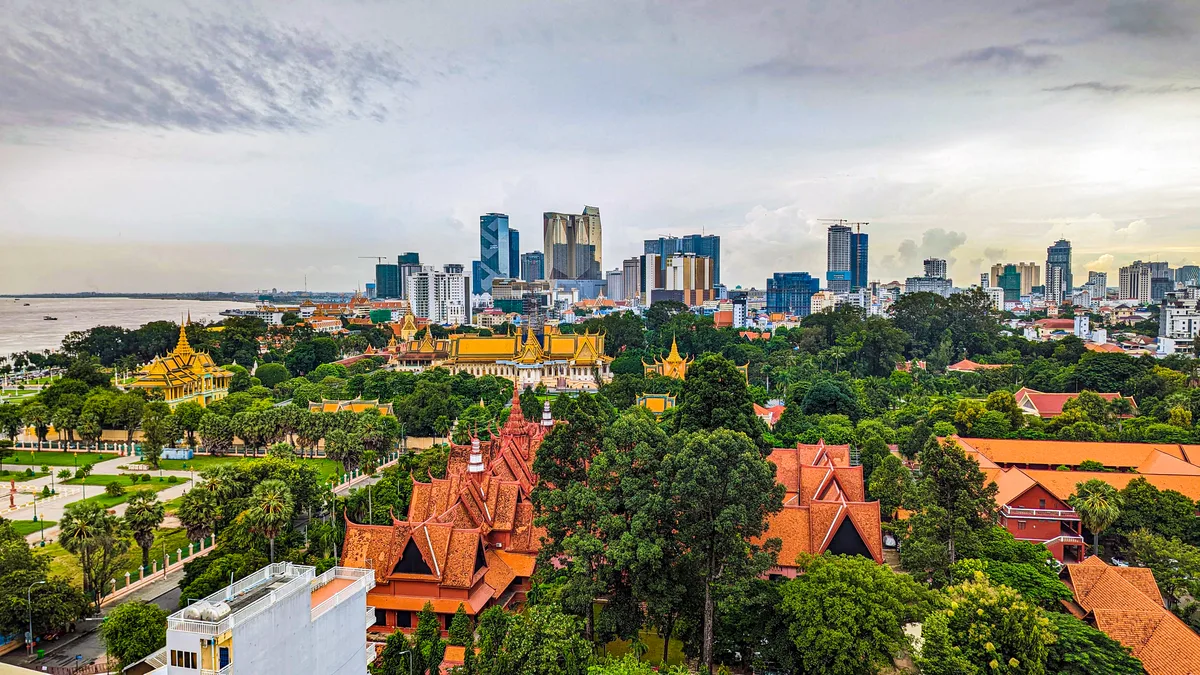
Header photo: Mao Piseth, CC BY-SA 4.0, via Wikimedia Commons. All credits: image credits.