Cambodia property tax for foreigners: on the way in, every year, on the rent, on the way out.
// Short answer
A foreign owner in Cambodia meets tax at four points. On purchase: 4 percent transfer tax on market value, paid by the buyer, and the title does not move until it is paid. Every year: 0.1 percent immovable property tax, which the tax authority describes as charged on 80 percent of value above a KHR 100,000,000 threshold. On rent: 14 percent withholding where the payer is a business. On sale: a 20 percent capital gains tax whose commencement for property is dated.
Rules and rates as of September 2026. Cambodia's capital gains tax on immovable property carries a commencement date that has moved more than once, so check every dated item again before you sign. Each section links its own sources.
On this page
- What taxes does a foreign property owner pay in Cambodia?
- What is Cambodia's annual property tax?
- How is rental income taxed for a non-resident owner in Cambodia?
- Is there capital gains tax on Cambodian property?
- Does Cambodia have a wealth tax or a second-home surcharge?
- Which tax stands between a buyer and the title?
What taxes does a foreign property owner pay in Cambodia?
Four, in order of when they hit. Transfer tax at 4 percent on purchase. Immovable property tax at 0.1 percent a year. Tax on rental income, with 14 percent withheld where a business pays a non-resident. And capital gains tax at 20 percent, which exists in the Law on Taxation but whose application to immovable property is deferred.
| Point | Tax and rate | Article |
|---|---|---|
| Buying | Transfer tax 4%, paid by the buyer, on market value, filed within 3 months | Law on Taxation Arts. 158(1), 159, 160, 162 |
| Holding | Immovable property tax 0.1% a year, on a committee-set value; the tax authority states a base of 80% of value and a KHR 100,000,000 threshold | Arts. 148, 149, 150, 151, 153; GDT FAQ |
| Holding vacant land | Unused land tax 2% a year, on a value set by a Land Evaluation Committee | Arts. 175, 176, 177, 179 |
| Renting | 14% withheld by a resident taxpayer carrying on business who pays a non-resident, and that withholding is final | Arts. 26, 27, 33(5) |
| Selling | Capital gains tax 20%, reaching non-residents on Cambodian gains, declared within 3 months; commencement for immovable property deferred | Arts. 165, 167, 168, 171 |
There is no separate foreigner rate in any of that. What differs for a non-resident is the withholding mechanism on rent, and the fact that a non-resident cannot use the principal-residence exemption on a gain.
Sources
What is Cambodia's annual property tax?
0.1 percent a year. Law on Taxation Article 150 sets the immovable property tax rate at 0.1 percent, Article 149 defines immovable property as land, houses, buildings and other construction, and Article 148 applies it to property located in the Capital-Provinces Administration.
The base is not your purchase price. Article 151 bases the tax on the value determined by an Immovable Property Evaluation Committee, with the base and the committee set by Prakas of the Minister of Economy and Finance. The General Department of Taxation states the practical parameters: 0.1 percent of a base equal to 80 percent of total property value, meaning land value plus construction cost, for property valued above KHR 100,000,000, declared and paid between 1 January and 30 September of each taxable year.
Article 153 puts the filing duty on the owner, occupant or final beneficiary. Article 152 lists the statutory exemptions: agricultural land, property owned by the Royal Government, ministries or government institutions, property of a body organised and operated exclusively for religion or charitable causes with no private benefit, property of foreign diplomatic or consular missions and international organisations, and infrastructure. The tax authority adds that agricultural land certified by the Department of Agriculture, and property in Special Economic Zones serving production activities, are exempt.
A separate unused land tax runs at 2 percent a year under Article 176, on a value set by a Land Evaluation Committee (Article 177), filed by the owner, occupant or final beneficiary (Article 179), with exemptions left to a Prakas (Article 178). The tax authority describes the same 1 January to 30 September filing window for it.
Sources
How is rental income taxed for a non-resident owner in Cambodia?
Rent from Cambodian property is Cambodian-source income under Article 33(5). Where a resident taxpayer carrying on business pays a non-resident, Article 26 requires 14 percent to be withheld, and Article 27 makes that the final tax on the recipient. The domestic comparison in Article 25(1)(b) is 10 percent.
The limit of that mechanism matters, and it is usually skipped. Article 26 imposes the duty on "any resident taxpayer carrying on business", meaning a business tenant or a business paying agent. Where the tenant is a private individual not carrying on business, no withholding agent arises under Article 26, and that chapter does not state how a non-resident landlord then accounts for the tax. So it is wrong to say 14 percent is automatically collected on every letting. The treatment where a private individual tenant pays a non-resident owner could not be established from a primary source for this page.
The tax authority describes rental income as subsidiary income for tax-on-income purposes and also subject to prepayment tax on income and minimum tax, which is the business-taxpayer route rather than the non-resident withholding route. If you are letting a Cambodian unit as a non-resident, that is the question to put to a Cambodian tax adviser in writing: which route applies to your actual tenant.
Sources
Is there capital gains tax on Cambodian property?
In the statute, yes: 20 percent. Article 168 sets the rate, and Article 165 reaches a non-resident taxpayer on capital gains from selling or transferring in Cambodia. But its application to immovable property has been deferred, most recently to 1 January 2027, and that date has moved more than once.
What the statute provides, when it does apply. Article 167 includes immovable property and leases in the definition of capital, and defines capital gains as taxable income from the sale or transfer of capital minus allowable expenses. Article 169 exempts, among others, the residence which is the taxpayer's principal place and immovable property transferred among a relative unit. Article 170 allows either a cost-base deduction or a standard deduction method. Article 171 requires declaration and payment no more than three months after the gain. Article 172 leaves rules and procedures to a Prakas of the Minister of Economy and Finance.
On commencement, this page relies on professional reporting rather than on a notification read directly. DFDL reported in January 2026 that the regime was set out in Prakas 496 MEF.PRK of 18 July 2025, that implementation for immovable property has been deferred to 1 January 2027, and that capital gains tax on other capital such as shares, leases, goodwill, intellectual property and foreign currency was scheduled to apply from 1 January 2026. The deferring notification number was not confirmed directly. The tax authority's own FAQ still describes capital gains as postponed, which is consistent.
Treat the 1 January 2027 date as dated and subject to change. Immovable-property capital gains tax has been postponed repeatedly since 2020. Re-check it before you model an exit.
Sources
Does Cambodia have a wealth tax or a second-home surcharge?
None was found in the Law on Taxation chapters reviewed for this page. Chapters 12 to 16 cover immovable property tax, transfer tax, capital gains tax, unused land tax and the tax on means of transportation. No wealth tax and no second-property surcharge appears among them.
That is a statement about what was read, not a promise that no such charge exists anywhere in Cambodian law or in a later instrument. It is the honest form of the answer, and it is the form to prefer over a flat "there is none".
The one recurring charge that is easy to forget is not a tax at all. Article 17 of the Law of 24 May 2010 requires special co-owners to participate in maintaining the common areas, divided in proportion to the value of each lot unless the internal rules say otherwise, and Article 20 penalises refusal as stated in Article 258 of the Land Law. No typical figure per square metre could be sourced, so get the building's actual schedule.
Sources
Which tax stands between a buyer and the title?
The transfer tax. Law on Taxation Article 163 provides that where it is unpaid, the Cadastral Administration shall not issue or transfer a land title or title of possession. Article 160 makes the buyer the taxpayer and Article 162 gives three months to file and pay.
That is the only tax gate on completion found in the instruments read, and it is the reason a Cambodian purchase timetable is really a tax timetable. Under the 2010 law, Article 8, the transfer is not effective until registered, so an unpaid 4 percent leaves a buyer holding a contract.
The full cost table, including what could not be sourced: Cambodia property buying costs. And whether a Cambodian tax identification number is needed by a non-resident buyer or filer could not be established from a primary source for this page, so it is not asserted either way.
Sources
// Buying in Cambodia?
Every listing in your budget, ranked on net yield, appreciation and resale. Any market with public listing data; book a free call first so I can confirm your city has the data.
See the $499 report, page by pageFrequently Asked Questions
What is the annual property tax in Cambodia?
Do foreigners pay more property tax in Cambodia?
Is 14 percent always withheld from rent in Cambodia?
When does Cambodia's capital gains tax on property start?
What is Cambodia's unused land tax?
Do I need a Cambodian tax number to buy?
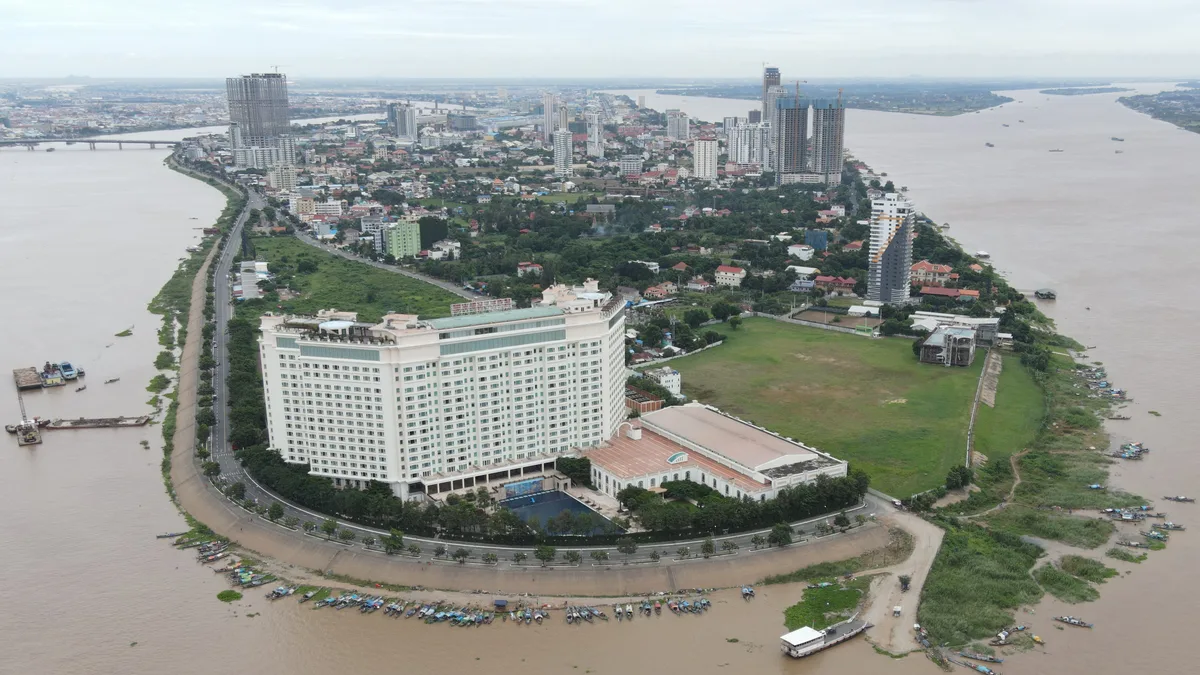
Header photo: Kiensvay, CC BY-SA 3.0, via Wikimedia Commons. All credits: image credits.