Buying property in Cambodia as a foreigner: a unit above the ground floor, never the land.
// Short answer
Yes. A foreigner can own a Cambodian condo unit outright, in their own name, with an ownership certificate from the Cadastral Authority. Three limits define what that means. The unit must sit on the first floor or above, never the ground or underground floors. The land under the building is never yours. And foreign ownership across the whole building is capped at 70 percent of the total floor area of its private units.
Rules and rates as of September 2026. Cambodia's capital gains tax on immovable property carries a commencement date that has moved more than once, so check every dated item again before you sign. Each section links its own sources.
On this page
- Can foreigners buy property in Cambodia?
- Can a foreigner own land in Cambodia?
- Which floors can a foreigner own in Cambodia?
- How much of a Cambodian building can foreigners own?
- What does it cost to buy a condo in Cambodia?
- What taxes does a foreign owner pay in Cambodia?
- Can a foreigner get a mortgage in Cambodia?
- What happens when a foreigner sells a Cambodian condo?
Can foreigners buy property in Cambodia?
Yes, but only one thing: a private unit in a registered co-owned building. The Law of 24 May 2010, Article 5, gives legally qualified foreigners ownership of private units and the right to use and enjoy the common areas. Land ownership stays closed.
The controlling statute is the Law on Providing Foreigners with Ownership Rights in Private Units of Co-Owned Buildings, Royal Kram NS/RKM/0510/006, promulgated 24 May 2010. It runs to 8 chapters and 24 articles. Article 4 defines a legally qualified foreigner as a foreign national with legal capacity under Cambodian law who has legally entered Cambodia, and defines foreigners to include both natural and legal persons, with no distinction by nationality, belief, religion or origin.
Article 3 applies the same co-ownership regime to foreigners and Khmer citizens. What differs is the bundle of rights over the common areas, not the ownership of the unit itself. And Article 8 makes registration the thing that counts: a transfer of special co-ownership is not effective until it is registered.
The document you end up holding, and what it states on its face: the Cambodian strata title, explained.
Sources
Can a foreigner own land in Cambodia?
No. Land Law 2001, Article 8: "Only natural persons or legal entities of Khmer nationality have the right to ownership of land in the Kingdom of Cambodia." The 2010 law repeats the point for condo buildings: the land parcel under a co-owned building cannot be owned by special co-owners.
One correction worth carrying, because it is the most repeated error on this subject. The land rule is Land Law Article 8, not Article 44. Article 44 of the 1993 Constitution is the general property-rights clause, and Land Law Article 44 deals with void possession titles over State public property and says nothing about foreigners. If a page, a broker or a forum post cites Article 44 for the land rule, it is citing the wrong provision.
Article 8 is also why the whole co-ownership route exists. A foreigner cannot be on the land title, so Cambodian law built a separate title class for the unit instead.
Where the building sits on land leased from a third party, Article 6 of the 2010 law provides that foreigners enjoy perpetual lease rights in private units in the same way Khmer citizens do.
Cambodian legal commentary also describes long-term leases and land-holding companies with majority Cambodian shareholding as alternative routes. Those were not confirmed against primary instruments for this page, so no maximum lease term and no shareholding percentage appears here. Get both from a named source before you build anything on them.
Sources
Which floors can a foreigner own in Cambodia?
First floor and above. Article 6 grants foreigners ownership of private units "only from the first (1st) floor up" and states that the ground floors and underground floors cannot be owned by foreigners. Cambodia counts the ground floor as level zero, so the lowest ownable level is one storey up.
Do not write "second floor". That phrasing only describes the right physical level for a listener using American numbering, and it contradicts the statute's own words.
The rule has teeth. Article 11 makes a transfer to a foreigner in violation of Article 6 null and void, with restitution by both parties. Article 22 gave foreigners who had bought in breach before the law took effect a two-year window to rectify their position, failing which the competent authority applies to court to force-sell the unit. That window closed in 2012 and is now history, but it is a fair measure of how the breach is treated.
Article 6 carries a second restriction that catches border-town projects: foreigners cannot acquire units in buildings within 30 kilometres of Cambodia's land borders, except in Special Economic Zones, important urban areas, and other areas the Royal Government designates. The law does not itself list which urban areas qualify.
The full rule, the numbering and what happens on a breach: Cambodia's ground floor rule, explained.
Sources
How much of a Cambodian building can foreigners own?
Up to 70 percent, measured by area. Sub-Decree No. 82 ANK.BK of 29 July 2010, Article 2, caps foreign ownership at "70 (seventy) percent of the total surface size of all private units of the co-owned building". It is not 70 percent of the number of units.
Two things get cited wrongly here, and both are checkable. The first is the measure: it is floor area, not a headcount. A building can be at the legal cap while foreigners hold well under 70 percent of the units, if the foreign-owned units are the larger ones.
The second is the instrument. The 2010 law states no percentage at all. Article 6 delegates it: a sub-decree shall determine the proportion and percentage of private units foreigners can own. The number lives in Sub-Decree No. 82, issued two months after the law. Naming "the 2010 law" as the source of the 70 percent is wrong.
A buyer can check the arithmetic on the paper itself. Sub-Decree 82, Article 3, requires the Cadastral Authority to write each unit's surface-size proportion, against the building total, onto the ownership certificate.
The cap in full, with the arithmetic of why area and unit count diverge: Cambodia's 70 percent foreign ownership cap.
Sources
What does it cost to buy a condo in Cambodia?
The one cost the statute names is transfer tax at 4 percent, charged on the property's market value, payable by the buyer, filed within three months. Until it is paid, the Cadastral Administration will not issue or transfer the title. Notary scales, agent commission and VAT on new builds could not be sourced for this page.
| Cost | Rate or amount | Charged on |
|---|---|---|
| Transfer tax, also called registration tax | 4% (Law on Taxation, Art. 158(1)) | Market value at the time of transfer; the Ministry of Economy and Finance may determine the value (Art. 159(1)) |
| Who pays it | The transferee, meaning the buyer (Art. 160) | Not apportioned by the statute |
| Filing deadline | Within 3 months (Art. 162) | The transfer |
| VAT on a developer's new-build sale | Not found in a primary source | Ask the developer for the tax treatment in writing |
| Notary and registry fee scale | Not found in a primary source | Quote, not a published percentage |
| Agent commission | Not found in a primary source | Quote, not a published percentage |
Note what the 4 percent is charged on. It is market value at the time of transfer, not necessarily the contract price, and the ministry may set the value for the tax base. So you cannot work the tax out from the price alone.
Every one-off cost, with the article that sets it: Cambodia property buying costs.
What taxes does a foreign owner pay in Cambodia?
An annual immovable property tax of 0.1 percent, which the tax authority describes as charged on 80 percent of value, for property valued above KHR 100,000,000, declared between 1 January and 30 September. Rent paid to a non-resident can carry 14 percent withholding. Capital gains tax at 20 percent exists but is dated.
- Annual: 0.1 percent immovable property tax (Law on Taxation, Art. 150), on a base set by an Immovable Property Evaluation Committee (Art. 151), filed by the owner (Art. 153). The General Department of Taxation states the base as 80 percent of total property value and the threshold as KHR 100,000,000.
- On rent: rent from Cambodian property is Cambodian-source income (Art. 33(5)). A resident taxpayer carrying on business who pays a non-resident must withhold 14 percent (Art. 26), and that withholding is the final tax (Art. 27). Where the tenant is a private individual not carrying on business, no withholding agent arises under Article 26, and the chapter does not say how a non-resident landlord then accounts for the tax. So do not assume 14 percent is collected on every letting.
- On sale: capital gains tax at 20 percent (Art. 168) reaches non-residents on Cambodian gains (Art. 165). Its application to immovable property has been deferred to 1 January 2027 per professional reporting of Prakas 496 MEF.PRK of 18 July 2025, and that date has moved more than once. Check it before you model an exit.
Every tax, at each of the four points: Cambodia property tax for foreigners.
Sources
Can a foreigner get a mortgage in Cambodia?
Plan on cash. Published guidance describes Cambodian bank lending to foreigners as oriented to people living and earning in Cambodia: local verifiable income, a clean title as collateral, source-of-funds documents, and often a longer-term visa or work permit. No lender's non-resident terms could be confirmed for this page.
Loan-to-value figures circulate for non-residents. None of them could be traced to a named lender's current published product terms, so none appears here. If a bank offers you terms, get them in writing before you sign a contract or pay a deposit.
One legal point sits underneath all of it. A strata unit's transfer is not effective until it is registered (Law of 24 May 2010, Art. 8), and only a properly registered title can be mortgaged cleanly. That is why a lender cares which title class a property carries before it cares about you.
Sources
What happens when a foreigner sells a Cambodian condo?
Registration is what makes the transfer effective, and the Cadastral Administration will not register it until the 4 percent transfer tax is paid. Your buyer pool is shaped by the same rules you bought under. The proceeds transfer out through a Cambodian bank, with no approval required.
Article 9 of the 2010 law sets out what happens at the moment of sale. Sell to a Khmer citizen and they acquire ownership of the unit plus undivided ownership of the common areas. Sell to another foreigner and the 70 percent area cap and the floor rule bind that buyer exactly as they bound you.
On the money: the Law on Foreign Exchange, Article 5, provides that there are no restrictions on transfers and capital flows between residents and non-residents, but that such operations must go through authorised intermediaries, which Article 5(2) defines as banks permanently established in Cambodia. Article 17 puts the reporting duty on the bank, for each transfer at or above USD 100,000.
The exit in order, including the dated capital gains position: selling a Cambodian condo as a foreigner.
Sources
// Buying in Cambodia?
Every listing in your budget, ranked on net yield, appreciation and resale. Any market with public listing data; book a free call first so I can confirm your city has the data.
See the $499 report, page by pageFrequently Asked Questions
Can foreigners buy property in Cambodia?
Can a foreigner own land in Cambodia?
Is the Cambodian foreign ownership cap 70 percent of the units?
Which floor can a foreigner buy on in Cambodia?
What is the transfer tax on a Cambodian property purchase?
Do I need to live in Cambodia to buy a condo there?
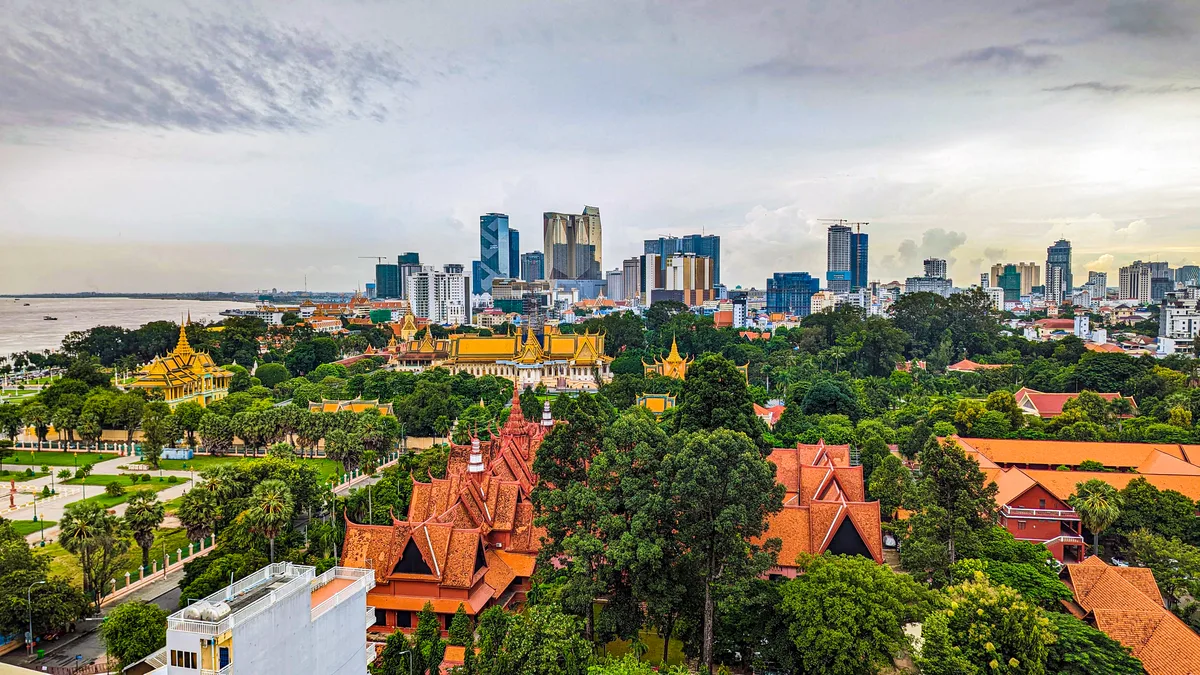
Header photo: Mao Piseth, CC BY-SA 4.0, via Wikimedia Commons. All credits: image credits.