Cambodia property buying costs: one statutory cost, and the ones nobody publishes.

// Short answer
One purchase cost in Cambodia is set by statute: transfer tax at 4 percent, charged on market value at the time of transfer, payable by the buyer, filed within three months. Until it is paid, the Cadastral Administration will not issue or transfer the title. VAT on new builds, notary and registry fee scales and agent commission norms could not be sourced from any primary source for this page, so no percentage for them appears here.
Rules and rates as of September 2026. Cambodia's capital gains tax on immovable property carries a commencement date that has moved more than once, so check every dated item again before you sign. Each section links its own sources.
On this page
- What does it cost to buy property in Cambodia?
- Who pays the transfer tax in Cambodia, buyer or seller?
- Is the 4 percent charged on the price you actually pay?
- What happens if the transfer tax is not paid?
- Are there exemptions from Cambodia's transfer tax?
- What if you buy the company instead of the property?
- How long does a Cambodian strata transfer take?
What does it cost to buy property in Cambodia?
The statutory cost is 4 percent transfer tax, under Law on Taxation Article 158(1), on the immovable property value. Article 160 puts it on the transferee, meaning the buyer. Article 162 gives three months to file and pay. Article 163 blocks the title transfer until it is settled.
| Cost | Rate or amount | Charged on, and the article |
|---|---|---|
| Transfer tax, also called registration tax | 4% | Immovable property value, Art. 158(1) |
| Who pays | The transferee, the buyer | Art. 160 |
| Base | Market value at the time of transfer; the Ministry of Economy and Finance may determine the value | Art. 159(1) |
| Filing and payment | Within 3 months | Art. 162 |
| Consequence of non-payment | The Cadastral Administration shall not issue or transfer the title | Art. 163 |
| VAT on a developer's new-build sale | Not found in a primary source | Ask the developer for the treatment in writing |
| Notary and registry fee scale | Not found in a primary source | Get a written quote |
| Agent commission | Not found in a primary source | Get it in the engagement letter |
Note what is absent from that list as much as what is in it. No notary is named anywhere in the 2010 law or in Sub-Decree No. 82. The actor the instruments name is the Cadastral Authority, which issues the certificate and writes the surface-size proportion onto it, and whose conduct Article 21 of the 2010 law polices. Whether a notarised deed is required in practice for a strata transfer could not be established from a primary source.
Sources
Who pays the transfer tax in Cambodia, buyer or seller?
The buyer. Law on Taxation Article 160 imposes the transfer tax on the transferee of the ownership or possession of immovable and movable property. Whatever a contract says about splitting it, that is the taxpayer the statute names.
Two consequences for a buyer's own arithmetic. First, the 4 percent is a cost on top of the price, not a deduction from the seller's proceeds. Second, because Article 163 blocks registration until it is paid, it is the buyer's own title that is held up by a shortfall.
Article 162 gives three months from the transfer to file the return and pay. Put the filing date in the same calendar entry as the completion date.
Is the 4 percent charged on the price you actually pay?
Not necessarily. Article 159(1) says the property value is calculated at the market value at the time of transfer, and that the Ministry of Economy and Finance may determine the value for this tax base. So the tax can be assessed on a value other than your contract figure.
Which means you cannot work the tax out from the price alone, and a budget built on 4 percent of the contract price is an estimate rather than a calculation. Ask the cadastral office or your adviser what value will be used, before you commit to the completion timetable.
The same distinction between price and assessed value shows up again on the holding side, where the annual tax runs on a value set by a committee rather than on what you paid: Cambodia property tax for foreigners.
What happens if the transfer tax is not paid?
The title does not move. Law on Taxation Article 163 provides that where the transfer tax is unpaid, the Cadastral Administration shall not issue or transfer a land title or title of possession of immovable property or similar title. And under the 2010 law, Article 8, an unregistered transfer is not effective.
Put those two together and the sequence is fixed: pay the transfer tax, register the transfer, own the unit. A paid purchase price on its own leaves you with a contract.
What the certificate looks like at the end of that sequence, and the one entry on it that is set by statute: the Cambodian strata title, explained.
Sources
Are there exemptions from Cambodia's transfer tax?
Several, and none of them is for an ordinary foreign buyer. Article 161 exempts acquisitions within a "relative unit", land in Royal Government concessions, property recorded to state institutions, and acquisitions by foreign diplomatic or consular missions and international organisations.
Article 157(1) defines the relative unit for that purpose: parents and legal children, husband and wife, grandparents and grandchildren, siblings, parents-in-law and children-in-law, grandparents-in-law and grandson-in-law. That is the family-transfer exemption, not a route for an arm's-length purchase.
So for a foreign buyer of a strata unit, budget the 4 percent in full.
What if you buy the company instead of the property?
The same 4 percent applies. Article 157(8) defines an immovable property company as one that directly or indirectly holds immovable property worth more than 50 percent of its total asset value. A transfer of shares in such a company is caught by Article 158(1), rather than the 0.1 percent ordinary share-transfer rate in Article 158(3).
So the share-purchase structure does not dodge the transfer tax where the company is property-heavy on that test.
A separate caution on the company route itself. Cambodian legal commentary describes land-holding companies with majority Cambodian shareholding as a way for foreigners to reach land, and commonly states a shareholding threshold. That threshold and the mechanics were not verified against a statute for this page, so no percentage appears here. Get it from a named source before it goes into a structure.
Sources
How long does a Cambodian strata transfer take?
The instruments set no period. The statutory clock that does exist is the three months in Article 162 to file and pay the transfer tax. A transfer of a hard, LMAP or strata title through the cadastral office is commonly described in market guidance as taking roughly 12 weeks, which is a market description rather than a legal timetable.
That 12-week figure comes from a named commercial publisher, realestate.com.kh, and the timing itself was not verified. Treat it as an expectation to test with the cadastral office and your own adviser, not as a date to write into a chain of transactions.
No mandatory lawyer or licensed agent appears as a legal requirement in the instruments read. The Law on Taxation and the 2010 law name the taxpayer, the Cadastral Administration and the cadastral authority. That is a statement about the law, not advice to go unrepresented.
Sources
// Buying in Cambodia?
Every listing in your budget, ranked on net yield, appreciation and resale. Any market with public listing data; book a free call first so I can confirm your city has the data.
See the $499 report, page by pageFrequently Asked Questions
How much is transfer tax on Cambodian property?
Who pays transfer tax in Cambodia?
Is there VAT on a new-build condo in Cambodia?
What is the agent commission on a Cambodian purchase?
Can I avoid the 4 percent by buying the owning company?
Do I need a notary to buy a condo in Cambodia?
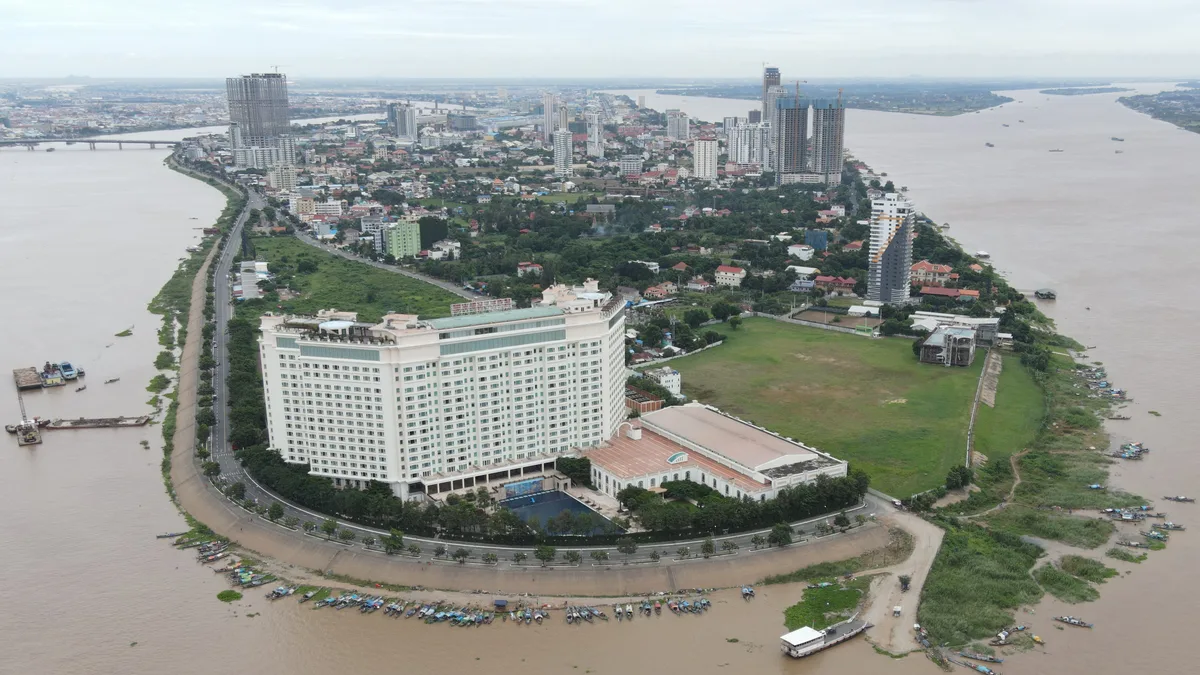
Header photo: Kiensvay, CC BY-SA 3.0, via Wikimedia Commons. All credits: image credits.