The gross yield is the brochure number. It ignores what the property costs to hold. Enter a price and a rent below and this returns the net yield, after vacancy, management, the building’s maintenance fee, and tax. That is the number you actually keep.
Edit the cost stack
vacancy · tax · fees
Maintenance is the building’s common-area fee (CAM), charged per m² each month, so it scales with unit size. Around 40 to 70 per m² is typical in Thailand. That works out to about 25,200 a year here. Rental income tax varies by country and by your own circumstances, so set it to your market’s rate. Edit any field to your own numbers.
Gross yield
6.0%
the brochure number
Net yield
3.6%
what you keep
Your yield shrinks ~40% from gross to net.
Annual rent (gross)$180,000
Net annual income$108,000
Net monthly$9,000
Estimates only, for education. This is not financial, tax, or legal advice. The pre-filled assumptions (tax, fees, vacancy) are simplified market averages from our own research, not a quote for any specific property, and your real tax depends on your residency and personal circumstances. Verify the specific building and take professional advice before you commit. Nothing here is a guaranteed outcome.
Rental yield by country
Yield does not travel. The gross-to-net gap is driven by local maintenance charges, vacancy, management norms and, above all, each country’s rental tax. Pick your market for a calculator pre-set to its real costs.
This calculator is the short version. The Yield Teardown is the institutional one: the full net-yield method worked on a real building, line by line. I will email it to you. Name and email, that is it.
Gross yield is what a listing advertises. It assumes the unit is rented every day, manages itself, and costs nothing to hold. None of that is true. Net yield subtracts the four costs that are always there: a vacancy allowance for the months between tenants, a management cost if you do not run it yourself, the building’s annual maintenance or service charge (often the single biggest line, and the one a listing never prints), and tax.
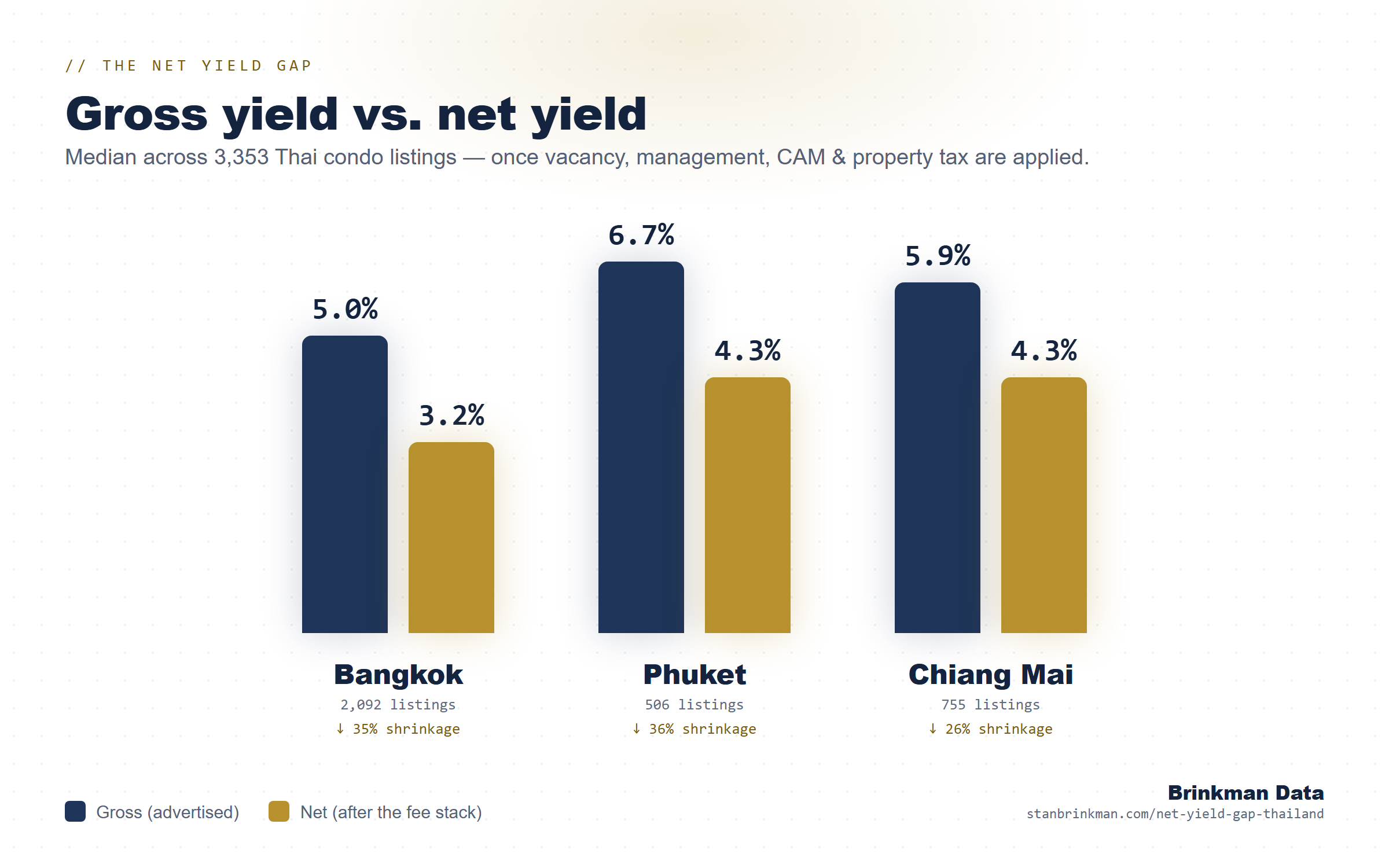
The gap between the two is predictable and large. Across a study of 3,300+ listings, the median gross figure lost roughly a quarter to a third of its value once the cost stack was applied. The shrinkage showed up in every sub-market measured. See the full net yield gap study, with the city-by-city data.
So when you compare two properties, compare the net figures, never the brochure gross. A 6% listing and a 7% listing can land at the same net once their maintenance fees are in. The headline rewards the seller; the net rewards you.
It depends on the market, but the figure that matters is the NET yield, not the gross. A headline gross yield typically shrinks by roughly a quarter to a third once vacancy, management, the maintenance fee and tax are applied. Compare net figures across options, never the brochure gross.
How is net rental yield different from gross?
Gross yield ignores the cost of holding the property. Net yield subtracts the real recurring costs: a vacancy allowance, a management cost, the building’s annual maintenance or service charge, and tax. The gap is predictable and large, and it is the figure most listings never publish.
What costs should I subtract to get net yield?
A vacancy allowance (commonly 10 to 15 percent), a management cost if you do not self-manage (commonly 10 to 15 percent), the building’s annual maintenance or service charge, property tax, and any other recurring costs such as insurance. This calculator applies all of them, and you can edit each assumption.
This calculator gives you the net number. The 5-step protocol gives you the rest: the quota check, the title and fee stack, and the walkouts, before a dollar moves.