Cambodia's ground floor rule, explained: first floor and up, never the ground.
// Short answer
Article 6 of Cambodia's 2010 foreign ownership law grants foreigners ownership of private units "only from the first (1st) floor up", and states that ground floors and underground floors cannot be owned by foreigners. Cambodia counts the ground floor as level zero, so the lowest level a foreigner can own is one storey above the ground. A transfer in breach is null and void.
Rules and rates as of September 2026. Cambodia's capital gains tax on immovable property carries a commencement date that has moved more than once, so check every dated item again before you sign. Each section links its own sources.
On this page
- Why can a foreigner not own the ground floor in Cambodia?
- Which floor is the first floor in Cambodia?
- What happens if a foreigner buys a barred floor?
- Does Article 6 restrict where in Cambodia a foreigner can buy?
- Can a foreigner own the land under a Cambodian building?
- What if the co-owned building stands on leased land?
Why can a foreigner not own the ground floor in Cambodia?
Because Article 6 of the Law of 24 May 2010 states it flatly: foreigners have ownership rights in private units "only from the first (1st) floor up", and the ground floors and underground floors cannot be owned by foreigners. The statute gives no reason for the rule.
What the statute does do, in the same article, is keep the land itself outside the foreign bundle: "In any case, the land parcel where the co-owned building is located cannot be subject to the ownership of special co-owners." Read alongside Land Law 2001, Article 8, which restricts land ownership to Khmer nationality, the ground and underground levels are the levels that are the land, or below it. That reading is an inference from the two provisions, not something either instrument says.
The practical version is simpler. Ground-floor and basement space in a Cambodian co-owned building is not part of what a foreign buyer can hold, however it is marketed.
Sources
Which floor is the first floor in Cambodia?
The level above the ground floor. Cambodia uses the convention in which the ground floor is level zero and the first floor is the storey above it. So the statute's phrase "from the first (1st) floor up" permits the first floor, and only the ground and underground levels are barred.
This is where most write-ups go wrong, in both directions.
- Wrong: "second floor and above". That contradicts the statute's own words, and it only describes the correct physical level for a reader using American numbering.
- Wrong: treating "ground floor" and "first floor" as the same thing, which makes the law sound as if it bars a level it expressly permits.
- Right: ground floor barred, first floor and above permitted. The lowest ownable level is one storey above the ground.
BNG Legal's July 2024 briefing quotes the "first (1st) floor up" wording as current, and the article is unamended as at September 2026.
Sources
What happens if a foreigner buys a barred floor?
Article 11 makes it null and void. Where a foreigner receives the transfer of or purchases a private unit in violation of Article 6, the transaction is void and the parties make restitution. This is not a filing you fix later; it goes to whether you own anything at all.
Article 22 shows how the transitional cases were handled. Foreigners who had bought in conflict with Article 6 before the law took effect were given two years to rectify their position, failing which the competent authority files with the court to force-sell the private unit. The law was promulgated 24 May 2010, so that window closed in 2012 and the provision is now historical. It is still the clearest indication of how the breach is treated.
Registration is the practical control point, because Article 8 makes a transfer of special co-ownership ineffective until registered, and the certificate is issued by the Cadastral Authority.
Does Article 6 restrict where in Cambodia a foreigner can buy?
Yes. Article 6 also provides that foreigners are not authorised to acquire ownership rights in private units located within 30 kilometres of Cambodia's land borders, and in other areas determined by the Royal Government, except in Special Economic Zones, important urban areas, and other areas the Royal Government determines.
The exceptions are wide, and the law does not itself list which urban areas qualify as "important". So for a project anywhere near a land border, the question is a factual one to put to the developer and to the cadastral office in writing: does this building fall inside the 30 kilometre strip, and if so, under which designation is foreign ownership permitted here?
The same Article 11 consequence applies to a purchase in breach of this part of Article 6 as to a barred floor.
Can a foreigner own the land under a Cambodian building?
No. Land Law 2001, Article 8, restricts the right to own land in Cambodia to natural persons and legal entities of Khmer nationality. Article 6 of the 2010 law says the same for co-owned buildings: the land parcel cannot be subject to the ownership of special co-owners.
The article number matters here, because the wrong one is everywhere. The land rule is Land Law Article 8. Article 44 of the 1993 Constitution is the general property-rights clause, and Land Law Article 44 is about void possession titles over State public property and says nothing about foreigners. A source citing Article 44 for the land rule has the wrong provision, which is a quick way to judge how carefully the rest of it was written.
Article 6 also keeps the common areas out of foreign ownership: they are kept for the common use of all co-owners, and Articles 4 and 15 give special co-owners only the right to use and enjoy them while Khmer co-owners hold undivided ownership.
Sources
What if the co-owned building stands on leased land?
Article 6's final paragraph covers it: where the co-owned building is constructed on land leased from a third party, foreigners enjoy perpetual lease rights in private units in the same way Khmer citizens do. So the position is equalised with a Cambodian buyer's, on the lease rather than on ownership.
That is a different structure from an owned unit with a certificate, so read the documents for which one you are actually being offered. The ownership certificate and what it states: the Cambodian strata title, explained. And the building-level limit that applies on top of the floor rule: Cambodia's 70 percent foreign ownership cap.
// Buying in Cambodia?
Every listing in your budget, ranked on net yield, appreciation and resale. Any market with public listing data; book a free call first so I can confirm your city has the data.
See the $499 report, page by pageFrequently Asked Questions
Why can't foreigners own the ground floor in Cambodia?
Can a foreigner own a first-floor unit in Cambodia?
Is it true foreigners must buy on the second floor or higher?
What happens if a foreigner buys a barred floor anyway?
Are there areas of Cambodia where foreigners cannot buy at all?
Does the ground floor rule mean I own the land above the first floor?
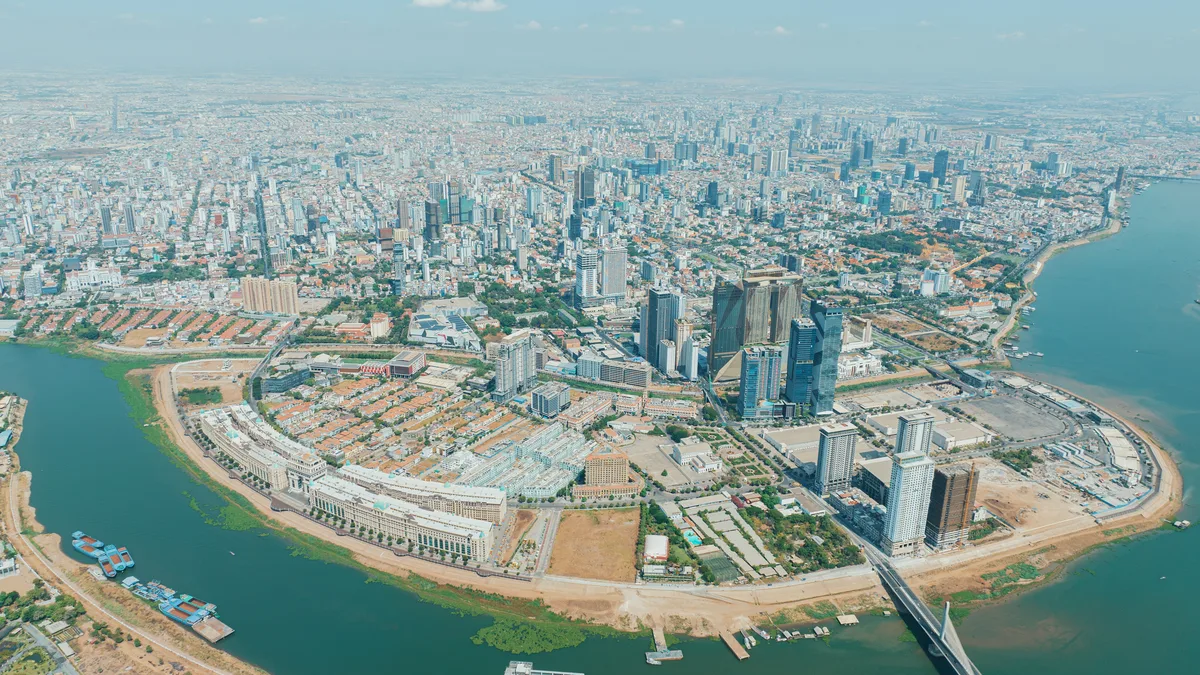
Header photo: Eva Berlinson, CC BY-SA 4.0, via Wikimedia Commons. All credits: image credits.