Buying property in Colombia as a foreigner: yes, full ownership. The money trail is the paperwork.

// Short answer
Yes. As of September 2026 a foreigner can own a home in Colombia outright, and buying one needs no prior government authorisation. What matters is the money. A foreigner's purchase is legally foreign direct investment, and paying through the Colombian exchange market registers it with Banco de la República, which protects your right to take the money out again.
Rules and rates as of September 2026. Colombian tax law was amended by emergency decree in 2026 and the minimum wage behind the visa threshold is under a transitional decree, so check the dated items again before you sign. Every figure links to its source.
On this page
- Can foreigners buy property in Colombia?
- Why is a property purchase in Colombia foreign investment?
- How does buying property in Colombia work, step by step?
- What does it cost to buy property in Colombia?
- What taxes does a foreign owner pay in Colombia each year?
- Can a foreigner rent out property in Colombia?
- What happens when a foreigner sells property in Colombia?
Can foreigners buy property in Colombia?
Yes. The Constitution gives foreigners the same civil rights as Colombians, and the foreign-investment rules state that making a foreign investment needs no authorisation, save for special rules. Ownership is full ownership (dominio). No nationality-based cap, quota or prior approval for buying a home was found in the regime, as of September 2026.
Some land cannot be owned privately by anyone, Colombian or foreign: property of public use, natural parks, communal lands of ethnic groups, resguardo lands and the archaeological heritage. Rural land the State originally adjudicated as baldío carries size limits tied to the local Unidad Agrícola Familiar (UAF), for every buyer. Whether any specific rule applies to foreigners in border or security zones was not confirmed for this page, so do not read it as a claim of no restrictions anywhere.
What a foreign owner holds, and the rules around it: foreign property ownership in Colombia, explained.
Sources
Why is a property purchase in Colombia foreign investment?
Because Decreto 1068 de 2015 lists the acquisition of real estate as foreign direct investment. Pay in foreign currency through an authorised bank or exchange intermediary, supply the data for the exchange declaration (Formulario No. 4), and the investment is registered with Banco de la República automatically. That registration is what matters later.
Once the investment is made and registered, the investor may send abroad, in freely convertible currency, the net profits of the investment and the money received from selling it. A foreign investor must also appoint an apoderado, a representative in Colombia. How the money goes in, step by step: transferring money to Colombia for a property.
Sources
How does buying property in Colombia work, step by step?
According to J&G Lawyers, the usual sequence is an offer and a promise contract, a title review, payment through the exchange market, the deed signed before a notary, payment of registration tax and registry fees, registration at the public registry (ORIP), and then Banco de la República registration if it was not automatic.
- Promesa de compraventa. The promise contract, usually with a deposit.
- Title review. Using the Certificado de Tradición y Libertad from the registry.
- Payment through the exchange market, with the exchange declaration.
- Escritura pública. The deed, signed before a notary. A notary is mandatory.
- Registration tax and registry fees, then registration at the Oficina de Registro de Instrumentos Públicos (ORIP).
- Banco de la República registration, if it was not automatic.
The document at the centre of the title review: the certificado de tradición y libertad, explained.
Sources
What does it cost to buy property in Colombia?
The main tax is the departmental registration tax, set by each department between 0.5% and 1% of the value of the deed. Notary and registry fees come on top. There is no VAT on new homes today and no 2% consumption tax on property sales: the first was repealed and the second was struck down.
The 2026 notary tariffs took effect in February 2026, and IVA is charged on top of notary fees. The exact notary and registry percentages could not be confirmed from the 2026 tariff texts for this page, so ask the notary for a written figure. The full list: Colombia property buying costs.
Sources
- Ley 223 de 1995, Art. 230, as modified by Ley 2069 de 2020 (registration tax)
- Superintendencia de Notariado y Registro: 2026 notary tariffs in force (February 2026)
- Estatuto Tributario, Art. 468-1 with vigencia notes (VAT on new homes)
- Estatuto Tributario, Art. 512-22 with vigencia notes (consumption tax on property)
What taxes does a foreign owner pay in Colombia each year?
Municipal property tax (impuesto predial unificado), set by each city between 5 and 16 per thousand (0.5% to 1.6%) of the cadastral value. A wealth tax applies to non-residents only where their net wealth held in Colombia is 72,000 UVT or more on 1 January (about COP 3.77 billion in 2026).
If you let the property, rent paid to a non-resident is subject to 20% withholding, and the non-resident income tax rate is a flat 35%. Whether the 20% is actually withheld depends on the tenant, which is covered in the full breakdown: Colombia property tax for foreigners.
Sources
Can a foreigner rent out property in Colombia?
Yes, with one rule to know first. Renting for periods of less than 30 days counts as tourist housing (vivienda turística), and tourism service providers must register in the Registro Nacional de Turismo (RNT) before they start. Longer lets are not tourist housing under that rule.
Anyone who appears to rent out more than one property for under 30 days is presumed to be a tourism service provider. The published yield figures, and what comes off them: Colombia rental yields.
What happens when a foreigner sells property in Colombia?
A gain on property held for two years or more is ganancia ocasional, taxed at 15%. A gain on property held for less than two years is ordinary income, which for a non-resident means the flat 35% rate. A registered investment lets you send the sale proceeds abroad in foreign currency.
An individual selling a fixed asset suffers 1% withholding on the sale value, paid before the notary executes the transfer. Whether and how that applies to a non-resident seller was not confirmed for this page. Step by step: selling property in Colombia as a foreigner.
Sources
- Estatuto Tributario, Arts. 292-3 to 300, Senate compilation, August 2026
- Estatuto Tributario, Arts. 314 and 316 (ganancia ocasional), Senate compilation, August 2026
- Estatuto Tributario, Art. 247 (non-resident rate), Senate compilation, August 2026
- Estatuto Tributario, Arts. 398 and 408 (withholding), Senate compilation, August 2026
- Decreto 1068 de 2015, foreign investment regime, as modified by Decreto 119 de 2017
// Buying in Colombia?
Every listing in your budget, ranked on net yield, appreciation and resale. Any market with public listing data; book a free call first so I can confirm your city has the data.
See the $499 report, page by pageFrequently Asked Questions
Can foreigners buy property in Colombia?
Do I need to live in Colombia to buy property there?
Does buying property in Colombia give me a visa?
Can a foreigner get a mortgage in Colombia?
Is there VAT on new homes in Colombia?
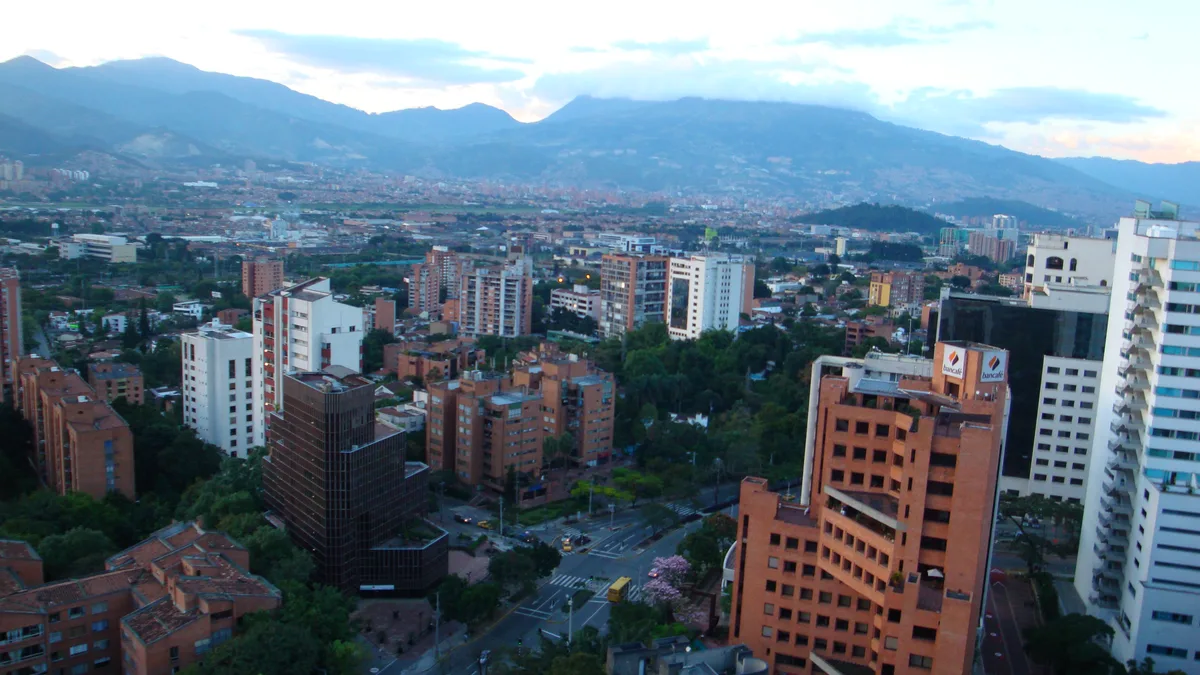
Header photo: User: (WT-shared) CONOCER at wts wikivoyage, Public domain, via Wikimedia Commons. All credits: image credits.