Transferring money to Montenegro for a property: euro, SEPA, and a bank account rule from May 2026.
// Short answer
Montenegro uses the euro and is part of SEPA, so a euro transfer from the EU is an ordinary SEPA payment. No currency-control approval was found for buying property or taking proceeds out. The rules that apply are anti-money-laundering: cash of €10,000 or more is declared at the border, and property payments of that size go through a bank.
Rules and rates as of September 2026. Montenegro changed its residence rules in January 2026 and is negotiating EU membership, and official sources disagree on the income tax rate, so check the dated items again before you sign. Every figure links to its source.
On this page
Do I need approval to send money to Montenegro to buy property?
None was found. No currency-control approval or repatriation restriction was identified in the sources read for this page. Montenegro uses the euro, and since October 2025 it has been operationally part of SEPA, so euro transfers from the SEPA area are SEPA transfers.
Montenegro joined the SEPA payment schemes' geographical scope in November 2024, per the European Commission.
Why does Montenegro use the euro?
By unilateral euroisation. The Deutsche Mark became sole legal tender from 1 January 2001, and the euro replaced it in March 2002. The Central Bank of Montenegro does not issue euros.
For a buyer with euros, there is no currency conversion on the purchase.
Can you pay for a Montenegro property in cash?
Not at €10,000 or more. Anti-money-laundering rules prohibit cash transactions of €10,000 or more; they go by bank transfer. A law firm reports that from 12 May 2026, a real estate payment of €10,000 or more requires at least one party to hold a transaction account with a Montenegrin bank.
The same amendments lowered the customer due-diligence threshold for occasional transactions from €15,000 to €10,000. The amending statute itself was not read for this page.
Sources
Do you declare cash at the Montenegrin border?
Yes, from €10,000. A traveller may carry up to €10,000, or the equivalent, in or out without declaring it. €10,000 or more, including cheques and other means of payment, must be declared to customs on entry or exit. Failure to declare is an offence, and the cash is temporarily seized.
Source: the Revenue and Customs Administration's traveller information.
Can a non-resident get a mortgage in Montenegro?
Assume cash. Global Property Guide reports a limited number of banks lending to non-residents at about 50% loan-to-value, often only for new builds from large or bank-accredited developers. Its bank data is old, so no current terms were confirmed for this page.
If a bank offers terms, get them in writing before you sign.
// Buying in Montenegro?
Every listing in your budget, ranked on net yield, appreciation and resale. Any market with public listing data; book a free call first so I can confirm your city has the data.
See the $499 report, page by pageFrequently Asked Questions
Does Montenegro have currency controls on property?
Is a transfer from the EU to Montenegro a SEPA payment?
Do I need a Montenegrin bank account to buy property?
How much cash can I bring into Montenegro?
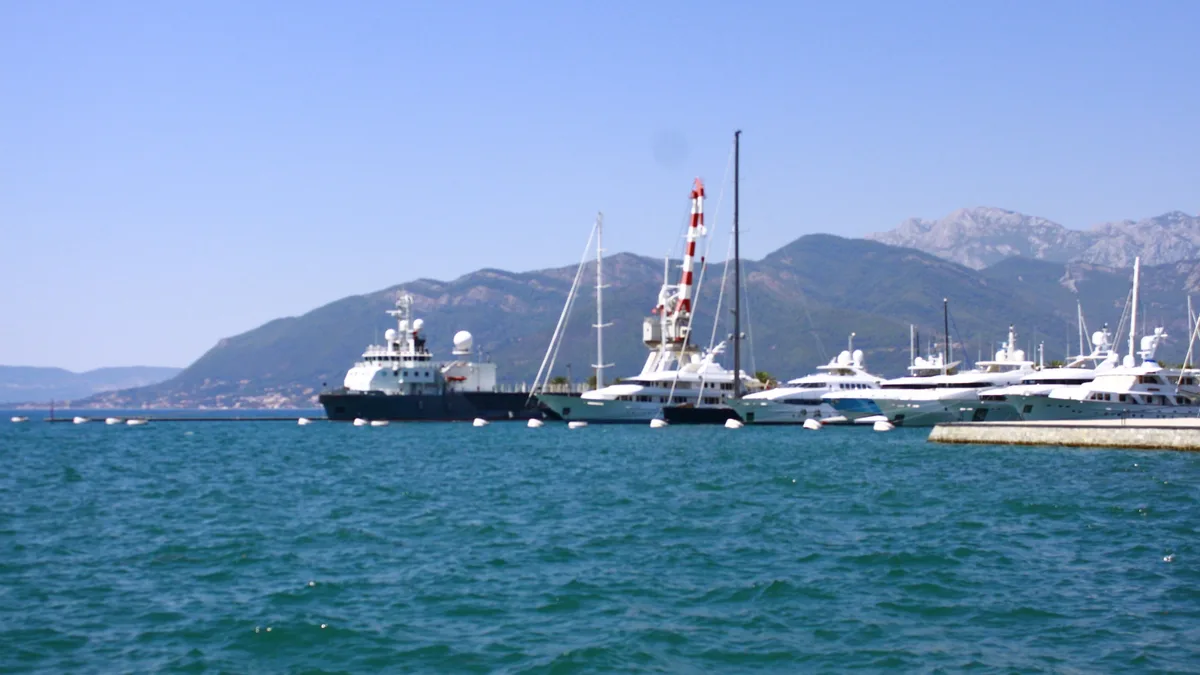
Header photo: T.Abdullayev (aka Ea…, CC BY-SA 3.0, via Wikimedia Commons. All credits: image credits.