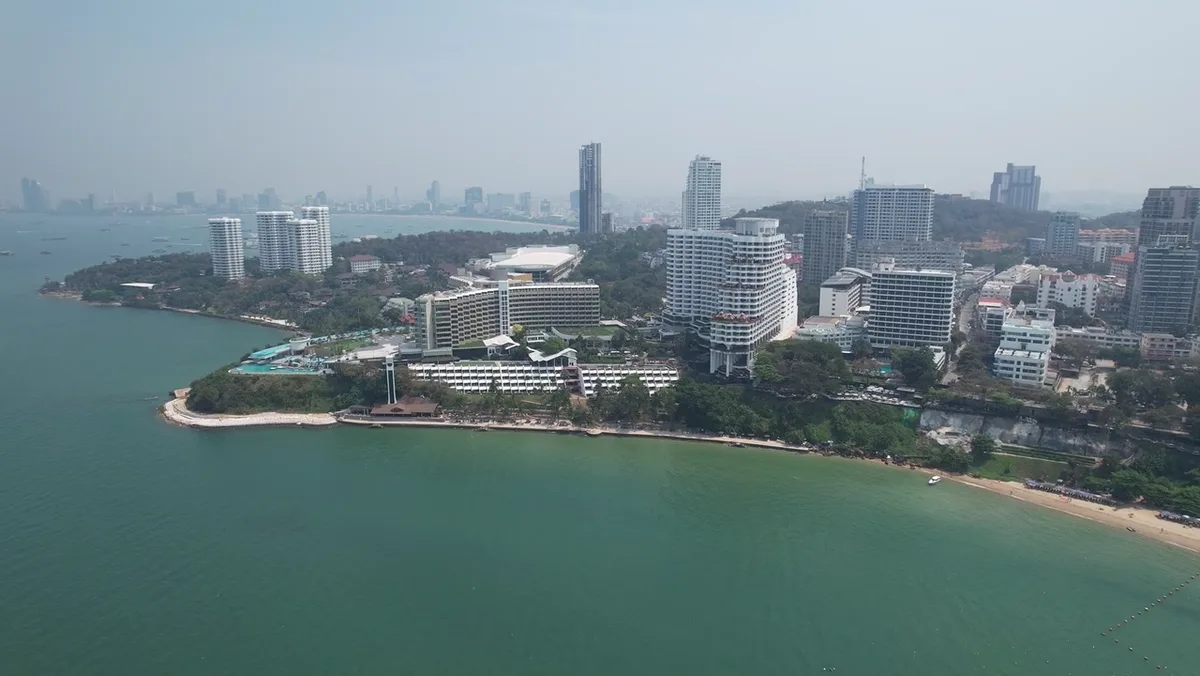
Pattaya net yields, building by building, with the negative ones left in.
Two Pattaya catchments carry enough rent evidence to underwrite: Nong Prue and Na Kluea with Wongamat. Fifty-one buildings cleared the standard out of 147 that qualified. Here is what they net, what is inside that word, and which building in the file nets below zero.

// Short answer
What is the net rental yield on a Pattaya condo?
Across the 51 Pattaya buildings that cleared rent validation in my September 2026 pull, the median building nets 3.79 percent. Split by catchment that is 4.00 percent across Nong Prue’s 37 buildings and 3.35 percent across the 14 buildings in Na Kluea and Wongamat. Every one of those figures is computed from what the rental platforms are asking, not from signed leases, and achieved rent sits below asking.
Pattaya is the fourth city in this line and the hardest one to report honestly. The sale-side pull ran to 8,125 rows and 4,903 distinct listings across 320 named buildings, which is plenty of inventory. The rent evidence is where it thins out: of 147 buildings that qualified on unit count, only 51 carried rent that could be cross-checked across more than one platform. Sixty-five percent of the candidate list did not make the file.
// Read this before you use any number below
These are asking rents, cross-checked across sources. Not achieved rents. The figure behind every net percentage on this page is a consensus of what several platforms advertise for units in that named building, held to the lower median wherever two platforms disagree materially. Nothing here tells you what a unit signed for. Achieved rent from an executed lease lands below asking, and the only practical source for it is a property manager running real books in that catchment. Treat every net figure below as the ceiling of a range, not the middle of one.
There is a second discipline on this page and it is worth stating outright: no purchase price appears anywhere on it. Not a median, not a band, not one building’s asking figure. A yield percentage printed next to a price reads as a promise about a specific unit, and it is not one. The price side of the same 51 buildings is published separately, on the Pattaya building file and on the Pattaya cost page.
What does net rental yield mean before any Pattaya number is quoted?
Gross yield is annual rent divided by capital deployed. Net yield is what is left after a 15 percent vacancy allowance, a 12 percent management cost, the building’s annual common-area charge and property tax are struck off. Every figure on this page is the net one. The gross figures behind them are not published here, because gross is the number that flatters and net is the number you live in.
Those four deductions are constants in my workbook, not judgement calls made per building, so the same arithmetic ran across all 51 rows. Vacancy at 15 percent. Management at 12 percent of what is left. The building’s common-area charge, annualised from its per-square-metre rate. Property tax modelled at 0.02 percent of value. If you want to argue with the model, argue with those four lines, because they are the whole difference between the advertised number and mine.
The management line is the one buyers delete first. Deleting it does not remove the cost. It moves the cost onto your own weekends and stops you invoicing for them.
What is the net median across Nong Prue’s 37 buildings?
Four point zero zero percent, across 37 buildings and 1,886 units. That is 84 percent of every unit in the file sitting in one tambon, which is why Nong Prue is where a Pattaya buyer actually has a choice. The rent consensus across those buildings is 398.7 baht per square metre per month.
Nong Prue is the administrative sub-district that contains Pratumnak Hill and a good deal of what buyers call Jomtien. The data reports by tambon because that is what it can evidence. It cannot separate Pratumnak from Jomtien, so this page does not pretend to, and any source that does split them should be asked what data performed the split.
Inside the tambon the building medians run from 2.84 percent at Centric Sea to 7.29 percent at Majestic Jomtien Condominium. Read that top figure with its sample attached: Majestic Jomtien contributes four units. The widest unit-level band in Nong Prue runs from minus 0.22 percent to 7.64 percent, and the section below is about the negative end of it.
Source: the June 2026 Pattaya pull, 4,903 distinct listings. A building reaches the file only when rent evidence agrees across more than one source.
What is the net median across Na Kluea and Wongamat’s 14 buildings?
Three point three five percent, across 14 buildings and 347 units, on a rent consensus of 372.7 baht per square metre per month. The unit-level band runs 1.51 percent to 6.69 percent. The lowest building median in the whole file sits here: Northpoint, ten units, 1.97 percent.
The gap between the two catchment medians is 0.65 percentage points, and the interesting part is why it points the way it does. Na Kluea and Wongamat is the beachfront-adjacent tier, and its rent per square metre is lower than Nong Prue’s, not higher. So whatever a buyer is paying extra for in that catchment, the rent is not recovering it.
That is not an argument against the catchment. It is an argument against buying into it with an income assumption attached. If the reason is the position and the build standard, those are legitimate reasons and the arithmetic simply says what it says. What the entry level actually is, in baht, is published on the file page rather than here, for the reason set out at the top.
Why does the Nong Prue range run below zero, and why was that building kept in?
The minus 0.22 percent belongs to Grande Caribbean, 105 units, sizes running 34 to 94 square metres, rent evidence multi-verified. At the top of that size range the modelled holding costs exceed what the validated rent covers. The building’s own median is 3.78 percent and its best band reaches 5.42 percent, so the negative is a large-unit outcome inside a building that is otherwise ordinary.
It stayed in the file because a file that publishes only the rows that work is a brochure with a spreadsheet on the cover. The negative is also the clearest possible demonstration of the mechanism that produces it: the common-area charge is levied per square metre and rent does not scale as neatly with size. Double the floor area and the monthly charge doubles. The rent does not.
Which is the single most useful thing on this page for anyone shortlisting in Pattaya. The large unit in the amenity-heavy tower is frequently the weaker net position, and it almost never looks like the weaker one on a viewing.
The same checks, as a step-by-step protocol you run on any Thai condo before you pay.
Get The $20 Thailand Underwriting ProtocolWhat costs are inside these net figures and what is left out?
Inside: vacancy, management, the building’s common-area charge and property tax. Left out: the transfer fee, the sinking-fund contribution, legal and due-diligence work, furnishing, and every cost of selling. A net yield is a holding figure. It is not a round-trip figure, and treating it as one is the most expensive arithmetic error a foreign buyer makes.
The four lines inside the net figure
- Vacancy, 15 percent. The months the unit is empty between tenants. Applied to every building equally.
- Management, 12 percent. Tenant placement, collection, coordinating repairs. Charged on what is left after vacancy.
- Common-area charge. Per square metre per month, annualised. Payable whether or not a tenant is in the unit.
- Property tax. Modelled at 0.02 percent of value, the constant used across the whole workbook.
// The weakest line in my own model, named
The common-area charge is the one line I cannot verify at scale. Only a small minority of the 4,903 Pattaya listings carried a published per-square-metre rate; for the rest the file estimates it from the building’s age and area cohort. That is a modelled line, and it is also the line most capable of moving a net figure by a full percentage point. Get the actual rate in writing from the building’s juristic office before you rely on any net number, including mine. If a building’s real rate comes back well above its cohort, every figure I have published for it is optimistic.
What sits outside the net figure entirely is the fee stack, and it is large enough to change a decision on its own. The full Pattaya version is set out in what it costs to buy a Pattaya condo, and the exit half of it in the guide to selling a Thai condo as a foreigner.
How is rent validated before a building enters the file?
Rental listings were collected from three platforms and grouped by named building: 10,110 from DotProperty, 2,779 from FazWaz and 998 from Thailand-Property, producing 13,583 retained comparables across 729 named Pattaya buildings. Each building gets a per-square-metre consensus, and a confidence tier that says how far the platforms were from each other.
The three tiers, and what each one means
- Multi-verified. Two or more platforms, agreeing within 20 percent. 57 of the 729 buildings reached it.
- Mild-divergent. Two or more platforms, 20 to 40 percent apart. 11 buildings.
- Single-source. One platform only, nothing to check it against. 654 buildings, and the reason most of Pattaya is not in this file.
Of the 147 buildings that qualified on unit count, 51 were published: 42 multi-verified and 9 mild-divergent. Of the 96 that were cut, 91 were cut because their rent came from a single platform and 5 on a data flag. Short-stay and serviced listings are stripped before any of this runs, because a nightly rate parses as a monthly rent and destroys the building’s median. Pattaya carries more of that inventory than any other city in this line, which is most of why the cut rate is 65 percent rather than the 30 to 40 percent it has been elsewhere.
All of which is a long way of saying the same thing the callout at the top says. This is what every platform is asking, and how far apart they are. It is a good deal more than one listing’s headline, and it is still not an achieved rent.
Why does rent per square metre matter more than a headline yield?
Because it is one observable number rather than a ratio of two, and because it is the number that moves when a building is genuinely better. Across the 51 published buildings the rent consensus runs from 239.1 to 707.7 baht per square metre per month, median 393.5. That is a spread of nearly three times, inside two catchments, in one city.
A yield can improve for two entirely different reasons: the rent went up, or the asking figure came down. Only one of those is a fact about the asset. Rent per square metre cannot be flattered by a motivated seller, which makes it the better first screen and the reason it is carried on every row of the file.
It also travels. If you are comparing Pattaya against the other Thai markets, the same measure is published for each: Bangkok, Phuket and Chiang Mai, with the country-level picture in Thailand rental yield and the gross-to-net shrinkage in the net yield gap study.
What separates a building that survives the arithmetic from one that does not?
Of the 51 published buildings, 9 net below 3 percent, 36 land between 3 and 5 percent, and 6 reach 5 percent or better. The spread inside Nong Prue alone is larger than the entire gap between the two catchments. The catchment is the small variable here. The building is the large one.
That is the conclusion the file was built to test, and it survived the test. Picking the right part of Pattaya moves the answer by well under one percentage point. Picking the right building inside that part moves it by several. Anyone choosing an area first and a building second has the order backwards.
One more thing is true of all 51: every one carries an observed foreign-quota marker. Observed means it was visible at the time of the pull, in September 2026. It is not a confirmation. Quota slots move, the position is per building, and the only body that can tell you where it stands is the building’s juristic office. Get it in writing before any deposit, and read how foreign freehold in a Thai condominium actually works first.
What to pull on a specific Pattaya building before you model anything
- The common-area rate per square metre, in writing from the juristic office, plus twelve months of invoices for the actual unit.
- The most recent sinking-fund call and any capital works already voted or pending.
- The remaining foreign-quota position for that building, in writing, before any deposit.
- Rent evidence from at least two property managers working that catchment, not portal asking rents.
- A vacancy assumption set to the letting model you will actually run, not to twelve paid months.
- Total capital deployed as the denominator: purchase, legal, the share of transfer costs you carry, furnishing.
- A stress test in which the rent drops and one extra month sits empty, and the position still clears your hurdle.
- The exit evidence: how long comparable units have sat unsold, and who is legally able to buy you out.
A net yield is four deductions. Here is the teardown.
Free. One email. Instant download.
- Where a headline yield loses a third of itself — the four lines struck between the advertised figure and the one you hold.
- Why the per-square-metre charge decides more than the rent — the line that turns a large unit into the weakest row in a building.
- What a sample size is worth — how to read any yield claim that arrives without one attached.
Independent research. Instant access. Unsubscribe in one click.