Buying property in Panama as a foreigner: yes, on local terms. The title is what you check.
// Short answer
Yes. Foreigners can buy and register titled property in Panama, condos and land included, on essentially the same terms as Panamanians, with no purchase permit. The limits are geographic: land within 10 km of the borders, the public beach strip, and islands. The question that decides a Panama purchase is whether the property is a registered title or only a possession right.
Rules and rates as of September 2026. Panama's investor-residency rules changed on 16 September 2026 and a short-rental tax bill is before the National Assembly, so check the dated items again before you sign. Every figure links to its source.
On this page
- Can foreigners buy property in Panama?
- What is the difference between titled property and possession rights in Panama?
- How does buying property in Panama work, step by step?
- What does it cost to buy property in Panama?
- What taxes does a foreign owner pay in Panama each year?
- What happens when a foreigner sells property in Panama?
- Can a foreign owner rent out property in Panama?
Can foreigners buy property in Panama?
Yes. Foreign individuals and companies can buy and hold registered property in Panama, land and condos included, on essentially the same terms as Panamanians, according to the US State Department's 2024 Investment Climate Statement and Global Property Guide. No nationality-based permit or approval is needed for an ordinary urban purchase.
The exceptions are written into the Constitution and Law 80 of 2009, and they are about location, not about who you are:
- Borders: no foreign person, and no Panamanian company with any foreign capital, may own land less than 10 km from the borders.
- Beaches: the public beach strip, 22 m inland from high tide on the Pacific and 10 m on the Atlantic, is not privately owned.
- Islands: island land can only be transferred under strict constitutional and Law 80 conditions.
- Foreign governments: may not own any part of Panamanian territory, embassy seats excepted.
Every rule in full: foreign property ownership in Panama, explained.
Sources
What is the difference between titled property and possession rights in Panama?
Titled property is a finca registered in the Registro Público, and registration is what perfects ownership. Possession rights (derechos posesorios) are a claim to occupy land that is not formally titled. The US State Department reports that a large portion of land, especially outside Panama City, is not formally titled.
A possession-rights parcel is not a registered finca. What changes hands is the possessory claim, and the buyer's position depends on later titling succeeding, according to RG Law Firm and the State Department. Titling runs through ANATI, the National Land Administration Authority, and needs more than five years of proven possession.
How the register works and what to ask for: Panama's Public Registry title, explained.
Sources
How does buying property in Panama work, step by step?
Offer, then a lawyer's title search at the Registro Público, then a promissory contract (promesa de compraventa) with a deposit, then closing by public deed (escritura pública) signed before a Panamanian notary, according to Global Property Guide. Taxes are paid and the deed is registered. Ownership transfers on registration.
- Offer.
- Title search. A lawyer checks the Registro Público for liens, debts and condo association arrears.
- Promesa de compraventa with a deposit.
- Public deed signed before a notary.
- Seller's taxes. The seller's transfer tax and capital-gains declarations are filed with the tax authority (DGI) and paid in the same calendar month. The capital-gains tax must be paid before the sale is registered.
- Registration of the deed at the Registro Público. This is when ownership transfers.
Before any of this, the bank will ask for a passport, a tax ID and a source-of-funds affidavit: transferring money to Panama for a property.
Sources
What does it cost to buy property in Panama?
The transfer tax (ITBI) is 2%, and by law it is the seller's tax, though contracts can allocate it differently. Global Property Guide quotes legal fees of about 2% and notary fees of about 0.10%, with the 3% to 5% agent fee paid by the seller. A first sale of new housing uses a separate reduced regime.
Global Property Guide puts the buyer's total at about 2.1% to 4.1%, depending on who bears the transfer tax. PwC gives rates of 0.5% to 4.5% for the new-housing regime, depending on property type and value. The full table: Panama property buying costs.
Sources
What taxes does a foreign owner pay in Panama each year?
Property tax on the cadastral value, on a progressive scale set by the tax authority (DGI): 0% up to B/.30,000, then 0.60%, 0.80% and 1.00% bands. A property registered as a primary residence uses a lower scale. Rent from Panamanian property is Panama-source income and is taxable for non-residents.
Panama has no net wealth tax and no inheritance, estate or gift tax, according to PwC. Property tax is paid in three instalments, with a 10% discount for paying the full year before 30 April. The full breakdown: Panama property tax for foreigners.
Sources
What happens when a foreigner sells property in Panama?
The seller pays capital-gains tax of 10% of the gain, with an advance of 3% of the higher of the sale price or cadastral value paid at transfer, according to PwC. The seller can treat the 3% as final or claim back any excess. The tax must be paid before the sale is registered.
The seller is also the taxpayer for the 2% transfer tax. There are no restrictions on moving capital out of Panama, according to the US International Trade Administration. Step by step: selling property in Panama as a foreigner.
Sources
Can a foreign owner rent out property in Panama?
Yes, on a normal lease. Short stays are restricted in the District of Panama: leases shorter than 45 days are prohibited there unless the property holds authorisation as public tourist lodging, according to Sucre Arias & Reyes. The restriction is limited to the District of Panama, which is Panama City.
Global Property Guide puts Panama's average gross rental yield at 6.94% for Q2 2026. That is the source's own gross figure, not a Brinkman Data calculation. The figures by area, and what comes off them: Panama rental yields.
Sources
// Buying in Panama?
Every listing in your budget, ranked on net yield, appreciation and resale. Any market with public listing data; book a free call first so I can confirm your city has the data.
See the $499 report, page by pageFrequently Asked Questions
Can foreigners buy property in Panama?
Do I need to live in Panama to buy property there?
Can a foreigner own beachfront property in Panama?
Does buying property in Panama give residency?
Is there a notary in a Panama property purchase?
What currency are Panama property prices in?
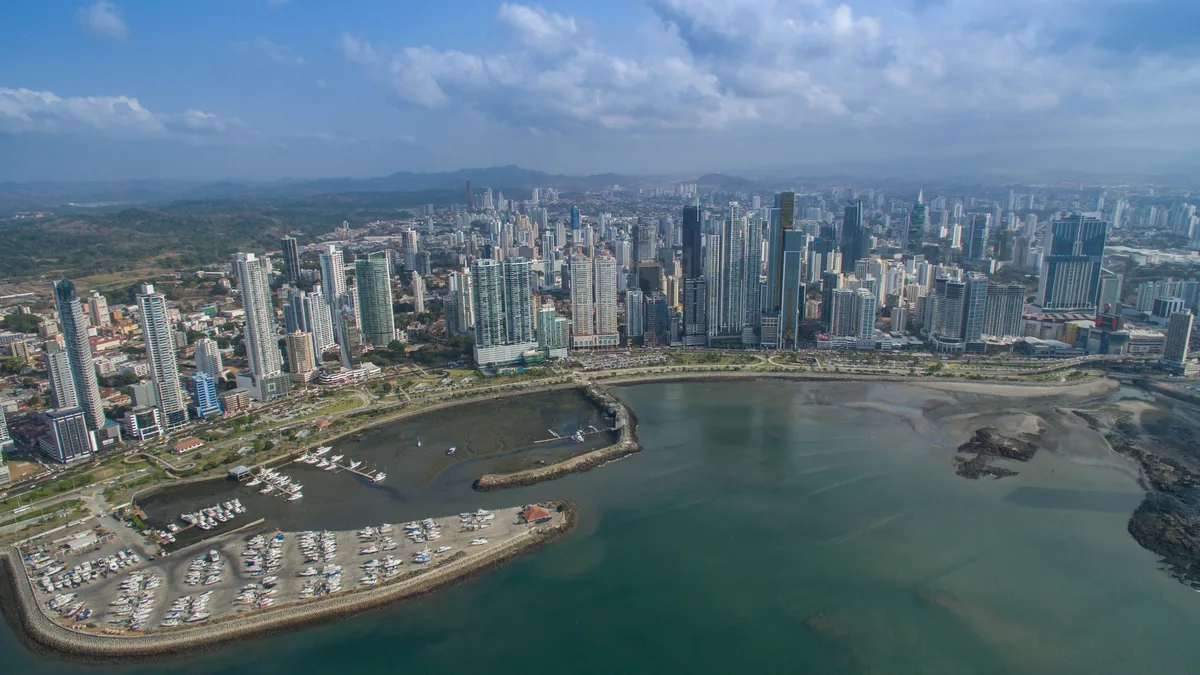
Header photo: Dronepicr, CC BY 3.0, via Wikimedia Commons. All credits: image credits.