Malaysia rental yields in 2026: the published figures, and what comes off them.

// Short answer
Global Property Guide puts Malaysia's average gross rental yield at 5.27% for Q1 2026, with Kuala Lumpur at 4.86%, George Town at 3.74% and Johor Bahru at 5.31%. Those are that source's gross figures, built from asking rents and list prices, and the same source says net is typically 1.5 to 2 percentage points lower. The spread inside a city matters more than the city average.
Rules and rates as of September 2026. Malaysia's minimum purchase prices for foreign buyers are set state by state, and the most recent consolidated all-states table is stated as at October 2024, so confirm the current figure with that state authority before you rely on it. Every figure links to its source.
On this page
What is the average rental yield in Malaysia?
Global Property Guide puts Malaysia's national average gross rental yield at 5.27% for Q1 2026, up from 5.19% in Q3 2025. The figures are gross, computed as median monthly rent times twelve over median purchase price, from asking rents and list prices, and the same source states net is typically around 1.5% to 2% lower.
These are that source's figures with its date attached, not a Brinkman Data calculation. A gross yield is rent before any cost, so it is a starting point for a question, not an answer to one. The costs that come off it are further down this page.
If you want to run your own numbers instead of a city average, the tool is here: Malaysia rental yield calculator.
What are rental yields in Kuala Lumpur, George Town and Johor Bahru?
On Global Property Guide's Q1 2026 data for apartments, all locations: Kuala Lumpur 4.86%, George Town 3.74% and Johor Bahru 5.31%. All three are gross figures from asking rents and list prices. They are citywide averages, and the spread inside each city is wider than the gap between them.
| City or area (Global Property Guide, Q1 2026) | Average gross rental yield |
|---|---|
| Malaysia, national average | 5.27% |
| Kuala Lumpur, all locations | 4.86% |
| George Town, Penang, all locations | 3.74% |
| Johor Bahru, all locations | 5.31% |
| Iskandar Puteri | 5.78% |
| Petaling Jaya | 5.43% |
| Ipoh | 5.46% |
| Shah Alam | 5.29% |
| Subang Jaya | 6.29% |
Every figure in the table is that source's gross figure for Q1 2026. Net is typically 1.5 to 2 percentage points lower, on the same source's own caveat.
Why does a city average mislead in Malaysia?
Because the unit size and the sub-market move the figure more than the city does. On the same Q1 2026 data, Kuala Lumpur runs 5.06% gross for a studio, 4.33% for a one-bedroom, 4.77% for a two-bedroom and 5.41% for a three-bedroom. Inside KLCC the figures are lower: studio 4.34%, one-bedroom 3.83%, two-bedroom 3.95%.
That is the single most useful line on the source's page: on these figures the prime address shows less than the citywide average. A four-bedroom or larger unit in Kuala Lumpur shows 4.73%.
| Cut (Global Property Guide, Q1 2026, gross) | Figure |
|---|---|
| Kuala Lumpur, studio | 5.06% |
| Kuala Lumpur, 1-bedroom | 4.33% |
| Kuala Lumpur, 2-bedroom | 4.77% |
| Kuala Lumpur, 3-bedroom | 5.41% |
| KLCC, studio | 4.34% |
| KLCC, 1-bedroom | 3.83% |
| KLCC, 2-bedroom | 3.95% |
| Johor Bahru, 1-bedroom | 6.01% |
| Johor Bahru, 2-bedroom | 5.22% |
| George Town, 2-bedroom | 4.33% |
| George Town, 3-bedroom | 4.11% |
- Johor Bahru's internal spread is extreme and thin. On the same page a Skudai two-bedroom shows 10.27% against a Skudai four-bedroom or larger at 4.01%, and a Tampoi four-bedroom or larger at 7.79%, on small samples. A single Johor Bahru number without the spread is not a useful number.
- George Town's average is not like for like. The source shows no studio or one-bedroom row for George Town, so its 3.74% average is not directly comparable with Kuala Lumpur's, which includes studios.
- One yield source only. Knight Frank Malaysia publishes half-yearly market reports and no yield percentage from them was obtainable, so nothing on this page is attributed to Knight Frank. No NAPIC yield series was located either.
Sources
What comes off a gross rental yield in Malaysia?
Four recurring lines and then tax. Quit rent to the state. Local authority assessment on annual value. Parcel rent where a state has implemented it for strata. The scheme's service charge and sinking fund, set by share units. Then income tax at a flat 30% of taxable rental income for a non-resident.
None of the four recurring lines has a national published rate. Quit rent is set by each state, assessment by each local authority within a statutory ceiling of 35% of annual value, parcel rent by the state where it applies, and service charge per scheme. Get the four actual figures for the actual unit before you model anything.
The entry and exit taxes sit outside the annual arithmetic but decide the whole hold: a flat 8% transfer stamp duty on the way in from 1 January 2026, and real property gains tax of 30% within five years or 10% from the sixth on the way out. The detail: Malaysia property tax for foreigners.
Sources
Can a foreign owner let a Malaysian unit short-term?
Do not assume it. Three separate layers have to clear: the scheme's own strata by-law or house rule, the local authority's licensing or planning requirement, and the express conditions and category of land use on the title. The first of those can close the question on its own.
- The scheme. On 5 October 2020 the Federal Court decided in favour of a management corporation that had made a house rule prohibiting use of residential units for business including short-term rental, holding that section 120 of the National Land Code and section 70 of the Strata Management Act 2013 can be read harmoniously and that the State Authority's conditions of use do not stop a management corporation making further rules or by-laws. A scheme's by-law can therefore ban short-term letting regardless of any licence.
- The local authority. No national short-term-let statute is in force. PLANMalaysia, under the Ministry of Housing and Local Government, has prepared a uniform planning guideline for short-term rental accommodation covering lettings of under six months, but it is reported as a reference for local authorities, still going through Cabinet and the National Council for Local Government, and not directly enforceable. This is a moving target.
- Penang has its own regime. The Penang Private Short-term Accommodation By-Laws 2026 are reported to have taken effect on 1 August 2026, with enforcement from 1 November after a two-month grace period, and to require operators of temporary income properties to be licensed by Penang Island City Council or Seberang Perai City Council. Every figure and condition reported for it comes from press reporting, not from the by-laws text, so get the by-laws before you plan around a fee.
Model a Malaysian unit on a long-term let unless the by-law, the licence and the title all say otherwise in writing.
Sources
- Federal Court of Malaysia: Innab Salil v Verve Suites Mont Kiara Management Corporation [2020] 10 CLJ 285, 5 October 2020 (as reported)
- iProperty: short-term rental in Malaysia, legal reality and risks
- New Straits Times: short-term rental rules under review (June 2025)
- Malay Mail: Penang introduces licensing for short-term rentals (21 August 2026)
Is there rent control in Malaysia?
No. The Control of Rent Act 1966 was repealed by the Control of Rent (Repeal) Act 1997, which received Royal Assent on 7 July 1997, was gazetted on 24 July 1997, and took effect on 1 September 1997. A dedicated residential tenancy statute was not found in force.
On a residential tenancy statute this page says not found rather than claiming one exists or that one does not. So the lease is the instrument that governs the letting, subject to the scheme's by-laws and the conditions on the title. Read the by-laws before you sign a tenant, not after.
Sources
// Buying in Malaysia?
Every listing in your budget, ranked on net yield, appreciation and resale. Any market with public listing data; book a free call first so I can confirm your city has the data.
See the $499 report, page by pageFrequently Asked Questions
What is the average rental yield in Malaysia?
Which Malaysian city has the highest rental yield?
Does KLCC yield less than the rest of Kuala Lumpur?
Can I let a Malaysian condo on Airbnb?
Is there rent control in Malaysia?
Are these gross or net yields?
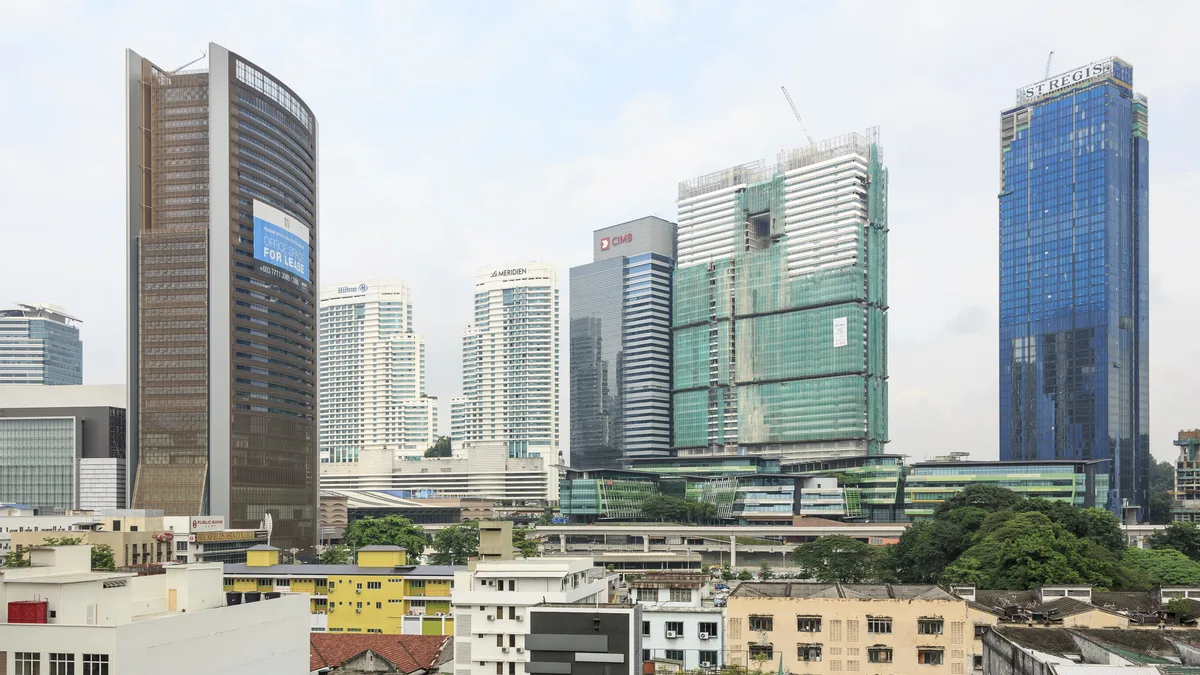
Header photo: CEphoto, Uwe Aranas, CC BY-SA 3.0, via Wikimedia Commons. All credits: image credits.