Can French citizens buy property in Thailand? Yes, a condominium. And the numbers say what they are buying.

// Short answer
Yes. Thailand's Condominium Act lets any foreign national hold freehold title to a condominium unit inside a building's 49 percent foreign allocation, and a French passport neither helps nor hurts. What is worth knowing before you start is that France is one of the ten largest foreign buyer groups in the Thai condominium market, that French buyers took 657 units in 2025 while the market as a whole barely moved, and that the units they registered were larger than those of every Asian buyer group in the same table.
Rules, forms and figures as of September 2026. This is research, not legal, tax or financial advice, and no page can tell you what applies to your own position. Confirm it with a qualified adviser and with the tax administration of the country you live in before you commit to anything. Every figure links to its source.
On this page
- Can French citizens buy property in Thailand?
- How many French buyers are there in the Thai condominium market?
- What size of unit do French buyers in Thailand actually register?
- What does Thailand require on the money side of the purchase?
- What does a French tax resident have to report at home about a Thai condominium?
- What does a French owner pay in Thailand, and on the way out?
Can French citizens buy property in Thailand?
Yes, a condominium unit. The Condominium Act lets a foreign national hold freehold title to a unit inside the 49 percent of a registered condominium's unit floor area allocated to foreign ownership. The rule is identical for every foreign nationality. Land is closed to foreign individuals, which closes a house on its own plot too.
Thailand does not sort foreign condominium buyers by nationality. A French buyer, a German buyer and a Taiwanese buyer meet the same quota, register at the same Land Office and receive the same unit title. Nothing in the Act gives any nationality a better or a worse position.
The quota is measured on floor area across the whole registered building, not on unit count. A building already at its foreign allocation cannot register another foreign owner until an existing foreign owner sells. Ask the juristic person for the building's current foreign allocation in writing, dated, before any deposit moves. A signed contract in a building that is already full is a contract that cannot be turned into a title.
The full ownership position, quota included: Thailand foreign freehold, explained.
Sources
How many French buyers are there in the Thai condominium market?
More than most people assume. REIC recorded 657 condominium units transferred to French buyers in 2025, worth 2,604 million baht. Units rose 26.1 percent year on year and value rose 16.6 percent. That put France sixth by transfer value and fifth by unit count in REIC's published top ten.
Read those numbers against the market they sit in. Foreign condominium transfers nationwide came to 14,899 units in 2025, up 2.2 percent on the year, while total transfer value fell 10.7 percent. So the French line rose on both measures inside a market that was flat on units and down on value.
Where France sits in the published table, ranked as REIC ranks it, by value:
| Rank by value | Nationality | Units 2025 | Units year on year | Value (THB m) |
|---|---|---|---|---|
| 1 | China | 4,940 | -12.9% | 18,585 |
| 2 | Myanmar | 1,968 | +41.8% | 6,159 |
| 3 | Russia | 1,172 | +8.6% | 4,773 |
| 4 | Taiwan | 1,036 | +23.9% | 4,699 |
| 5 | United States | 537 | -11.8% | 2,810 |
| 6 | France | 657 | +26.1% | 2,604 |
| 7 | United Kingdom | 476 | +15.0% | 2,298 |
| 8 | Germany | 459 | +2.9% | 1,849 |
One thing to note about that table. REIC ranks it by value, so the United States appears above France on 120 fewer units. Counted by units, France is fifth.
The whole published table, with every nationality: who buys Thai condominiums, by nationality.
Sources
What size of unit do French buyers in Thailand actually register?
A large one by the standards of that table. REIC puts the average French transfer at 47.9 m2 and about 4.0 million baht. The national average across all foreign transfers in 2025 was 41.3 m2. Every Asian buyer group in the top ten averaged smaller: China 35.6 m2, Myanmar 32.9 m2, Taiwan 35.7 m2, Singapore 37.3 m2.
That gap is the most useful thing in the French line, because unit size is a proxy for what the unit is for. A 33 m2 average points at studios and one-bedroom stock. A 48 m2 average points at one-bedroom and two-bedroom stock, which is a different comparable set, a different tenant, and a different resale pool.
The arithmetic that follows from the same two REIC columns is also worth having. 2,604 million baht across 31,476 m2 of French-registered floor area works out to roughly 82,700 baht per m2, against roughly 99,000 baht per m2 for all foreign transfers. So the French average is a larger unit at a lower price per square metre. That is a statement about the stock and the catchments, not about anybody's negotiating.
Two things this page will not tell you, because no published source supports them.
- Which provinces French buyers chose. REIC named provinces for Chinese, Myanmar and Russian buyers at its results briefing and did not name them for France. There is no public province split for French buyers in any REIC source, so this page does not guess at one.
- Why they bought. No REIC or other official source publishes motives for French buyers. Anything you read on that is somebody's inference.
The nationwide province table is published, and it is the honest substitute: Bangkok 7,029 units, Chonburi 4,164, Phuket 1,190, Chiang Mai 848, Prachuap Khiri Khan 491. That is where foreign transfers happened in 2025 across all nationalities.
Sources
What does Thailand require on the money side of the purchase?
Evidence that the purchase money arrived in Thailand from abroad in foreign currency. For an inward remittance at or above the reporting threshold the receiving Thai bank issues a Foreign Exchange Transaction document in the buyer's own name, and the Land Office wants that document at transfer. It is also what supports taking the proceeds out later.
Two details decide whether the document is usable. It must be in the buyer's own name, and the stated purpose must be the purchase of the unit. A remittance that lands in a third party's name, or that arrives already converted into Thai baht offshore, is the common way a completion stalls at the counter.
Sending euros out of France to Thailand is not restricted, and this page does not describe any route around any requirement on either side. Banks and payment providers run their own checks, those checks differ between institutions, and they change. Confirm your own position with your own bank, in writing, before you commit to a price or a completion date.
How the document works and what the bank needs from you: the Thailand FET certificate guide.
Sources
What does a French tax resident have to report at home about a Thai condominium?
Three separate things. Worldwide income, because Article 4 A of the Code general des impots makes a person with their tax domicile in France liable to income tax on the whole of their income. Net real estate wealth including property held outside France, under the IFI. And any bank account opened, held, used or closed abroad.
The France and Thailand convention signed in Bangkok on 27 December 1974 decides what happens to the rent itself. Article 6(1) makes income from immovable property taxable in the State where the property is situated. Article 23(1)(a) then exempts that income from the French taxes listed in Article 2(3)(a) when it is taxable in Thailand under the convention and Thai law, and Article 23(1)(c) lets France compute French tax on the income that stays taxable in France at the rate corresponding to total income under French law. That last point is the one people miss. Exempt is not the same as invisible.
On the form side, the official notice to form 2047 says that foreign rental income exempt in France but retained for the effective rate is not entered on form 2047 at all. It goes directly on form 2042 C, line 4EA under the regime reel or line 4EB under the micro regime, without being carried to line 8TI.
The IFI is separate from all of that. Article 964 of the Code general des impots makes a person with their tax domicile in France liable on real estate assets situated in France or outside France once the net taxable value exceeds 1,300,000 euros, assessed on 1 January. A Thai condominium is inside that scope. There is a five year rule for people who were not tax resident in France in the five preceding years, which limits them to property situated in France for that period.
The whole French side, with the treaty articles and the form lines: French tax and reporting on property abroad.
Sources
- Legifrance: Code general des impots, Article 4 A (worldwide income of persons domiciled in France)
- impots.gouv.fr: France and Thailand tax convention of 27 December 1974 (full text PDF, Articles 6 and 23)
- impots.gouv.fr: notice 2047-NOT (revenus 2025), lines 4EA and 4EB of form 2042 C
- Legifrance: Code general des impots, Article 964 (IFI, property in France or outside France, 1,300,000 euros)
What does a French owner pay in Thailand, and on the way out?
On the Thai side there is transfer tax and duty at registration, a yearly land and building tax, and tax on rental income. On sale there is a transfer fee and, depending on how long the unit has been held, either specific business tax or stamp duty, plus withholding at the Land Office. Budget the exit before you budget the entry.
None of this is nationality based. A French owner and a Thai owner meet the same schedule on the same unit. What a foreign owner has that a local owner does not is the inward remittance record, which is what supports taking the proceeds back out afterwards.
The holding-side figures and the filing points: Thailand property tax for foreigners. The exit, step by step: selling a Thai condominium as a foreigner.
Sources
// Buying abroad?
Every listing in your budget, ranked on net yield, appreciation and resale. Any market with public listing data; book a free call first so I can confirm your city has the data.
See the $499 report, page by pageFrequently Asked Questions
Can a French citizen own a condominium in Thailand outright?
Can a French citizen buy land or a house in Thailand?
How many Thai condominiums did French buyers take in 2025?
Where in Thailand do French buyers buy?
Are French buyers buying bigger units than other groups?
Does a French resident pay French tax on rent from a Thai condominium?
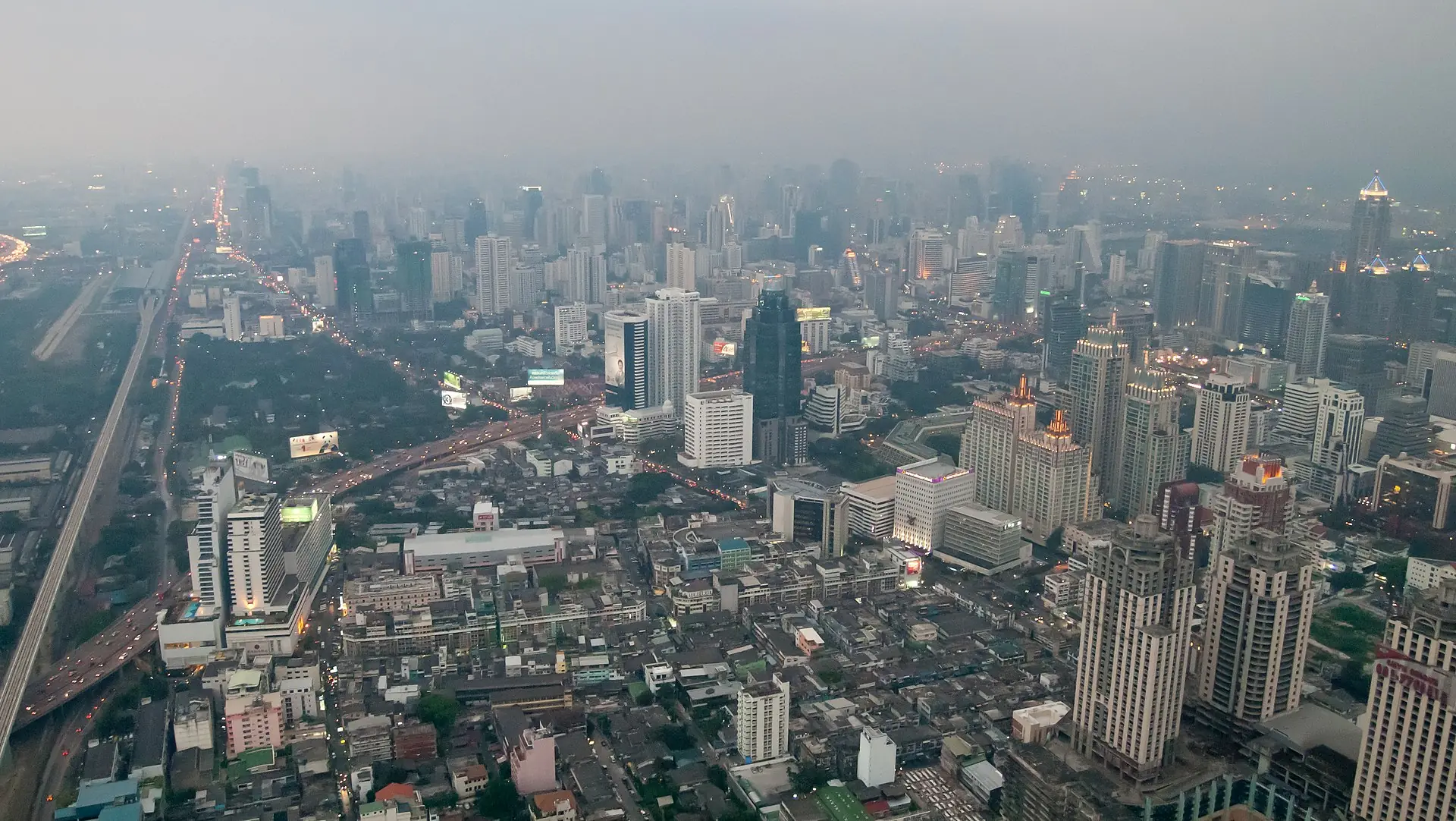
Header photo: Vyacheslav Argenberg, CC BY 4.0, via Wikimedia Commons. All credits: image credits.