Can French citizens buy property in Spain? Yes. And three Spanish rules treat you differently because you are French.

// Short answer
Yes. Spain has no general nationality or residency restriction on buying urban residential property, and a foreign buyer takes full ownership recorded in the Property Registry the same way a Spanish buyer does. What is worth knowing is that three separate Spanish rules turn on whether the buyer holds the nationality of, or is tax resident in, an EU member state. A French buyer is on the favourable side of all three.
Rules, rates and forms as of September 2026. This is research, not legal, tax or financial advice, and no page can tell you what applies to your own position. Confirm it with a qualified adviser and with the tax administration of the country you live in before you commit to anything. Every figure links to its source.
On this page
- Can French citizens buy property in Spain?
- Does Spain's defence-zone authorisation apply to a French buyer?
- Would the proposed 100 percent tax on foreign buyers hit a French buyer?
- What does a French buyer pay to buy, and to hold, in Spain?
- How is a French owner's Spanish rental income taxed?
- Does money have to be declared moving from France into Spain?
Can French citizens buy property in Spain?
Yes. There is no general nationality or residency test on buying urban residential property in Spain, and what a foreign buyer receives is full ownership (pleno dominio), recorded in the Registro de la Propiedad on the same basis as for a Spanish buyer. What a French buyer needs is a Spanish foreigner identification number, the NIE.
No single Spanish government page states the positive rule in one sentence. It follows from the absence of any general restriction, plus the one restriction regime that does exist, which is covered in the next section.
The NIE is an identification and tax number, not a residence permit. It is requested with form EX-15 and the fee under modelo 790 codigo 012, either in Spain at a police station or foreigners' office, or from abroad through a Spanish consulate. The maximum resolution time is five days.
The register and the deed: the nota simple and the NIE, explained. The full ownership position: Spain property foreign ownership explained.
Sources
Does Spain's defence-zone authorisation apply to a French buyer?
No. Ley 8/1975 requires military authorisation for foreigners acquiring property in zones with restricted access to foreign ownership, but an additional provision added by Ley 31/1990, in force from 17 January 1991, states that those limitations do not apply to natural persons holding the nationality of an EU member state. A French individual is outside the regime.
This is the first of the three EU distinctions, and it is a real one rather than a technicality. The restricted zones cover a large number of municipalities, including the Balearic and Canary archipelagos, and where the regime does apply, an acquisition made without the prior authorisation is ineffective and has to be done again.
Two limits on how far to take this. The exemption in the statute is for natural persons with EU nationality, so a purchase made through a company is a different question and one for a Spanish lawyer. And the detail of which land and which municipalities are caught sits in the implementing regulation, which was not read for this page. If the property is rural land in an island or border area, ask the notary to confirm the position in writing before signing.
Would the proposed 100 percent tax on foreign buyers hit a French buyer?
On its own text, no, and it is not law in any case. The measure is Article 4 of a parliamentary bill filed in May 2025 that would apply a 100 percent rate to acquisitions of Spanish real estate by persons and entities not resident in the European Union. As of September 2026 the Congreso record still shows it awaiting its first plenary vote.
The two things to hold on to, both checkable on the Congreso's own record. First, the test in the bill is residence outside the European Union, so on the published text a buyer resident in France would be outside its scope. Second, the bill has not passed even the vote to take it into consideration, which it has been awaiting since 5 September 2025.
This page reports the status of a bill and takes no position on it. Anything you read describing it as a tax that exists is describing a proposal. Check the Congreso record before you price anything around it.
Sources
What does a French buyer pay to buy, and to hold, in Spain?
On a resale from a private seller, transfer tax (ITP) at a rate set by each autonomous community, charged on the higher of the cadastral reference value and the price. On a new build from a developer, 10 percent VAT plus regional stamp duty. Then, every year, municipal IBI on the cadastral value, at a rate between 0.4 and 1.10 percent.
The regional spread on transfer tax is the number that moves the total, and it is set regionally, not nationally.
| Region | General ITP on a residential resale |
|---|---|
| Andalucia | 7 percent flat |
| Catalonia | 10 percent to 600,000 euros, 11 percent to 900,000, 12 percent to 1,500,000, 13 percent above (scale from 27 June 2025) |
| Comunitat Valenciana | 9 percent, 11 percent where the value exceeds 1,000,000 euros |
| Illes Balears | 8 percent to 400,000 euros, rising in bands to 13 percent above 2,000,000 |
Where a region has set no rate, the state fallback for real estate is 6 percent. Regions also set the stamp duty rate on a new-build deed, with a state fallback of 0.50 percent. Reduced rates exist for young buyers, large families and protected housing, but they generally require the property to be the buyer's habitual residence, so they rarely reach a non-resident buyer.
One more holding cost that is easy to miss: a non-resident who keeps the property for their own use or leaves it empty pays non-resident income tax on an imputed income every year, at 1.1 percent of the cadastral value where the municipality's values were revised from 1 January 2012, or 2 percent otherwise. Every purchase cost in one table: Spain property buying costs.
Sources
- BOE: RDLeg 1/1993, Texto refundido de la Ley del ITPAJD, articles 10.2, 11.1.a and 31.2
- Agencia Tributaria de Catalunya: ITP tariffs and rates
- BOE: Ley 37/1992 del IVA, articles 20.Uno.22 and 91.Uno.1.7 (10 percent on dwellings, exemption on resales)
- BOE: RDLeg 2/2004, Ley Reguladora de las Haciendas Locales, article 72 (IBI rates)
- AEAT: imputed income of an urban property for own use (1.1 percent and 2 percent, modelo 210)
How is a French owner's Spanish rental income taxed?
Under non-resident income tax, at 19 percent for residents of the EU, Iceland and Norway, against 24 percent for other taxpayers. And residents of an EU or EEA state with effective tax-information exchange may deduct expenses directly related to the Spanish income, where other non-residents are taxed on gross rent with no deduction. It is declared on modelo 210.
Those are the second and third EU distinctions, and together they are the largest single difference between a French owner and, say, a British or American one holding the identical flat. A lower rate on a smaller base is a different tax on the same rent.
On a sale, the gain is taxed at 19 percent for all non-residents, EU or not, and the buyer must withhold 3 percent of the agreed price on modelo 211 within one month of the transfer, as a payment on account. The seller then files modelo 210 within three months after that period, and any excess withholding is refundable. The municipal plusvalia on the increase in value of the urban land is a separate charge.
One thing a French buyer should raise with an adviser rather than read on a page. Spain charges a wealth tax on non-residents in respect of assets situated in Spain, with a 700,000 euro exempt minimum and a state scale, plus a temporary solidarity levy above 3,000,000 euros. France charges the IFI on a French resident's real estate in France and outside France. Both can be in play on the same flat at the same time, and how they interact in a given case is a question for a professional, not for a web page.
The Spanish tax detail: Spain property tax for foreigners. The French side: French tax and reporting on property abroad.
Sources
- AEAT: income from let property, non-resident income tax (gross basis, EU/EEA expense deduction)
- AEAT: non-resident income tax rates without a permanent establishment (19 percent and 24 percent)
- AEAT: capital gain on a transfer by a non-resident (19 percent, 3 percent buyer withholding on modelo 211)
- BOE: Ley 19/1991 del Impuesto sobre el Patrimonio, articles 5, 28, 29, 30 and DA 4 (non-residents, 700,000 euro minimum)
- Legifrance: Code general des impots, Article 964 (IFI, assets in France or outside France)
Does money have to be declared moving from France into Spain?
Foreign investment into Spain, including buying real estate, is liberalised. A non-resident's purchase of Spanish real estate has to be declared to the Registro de Inversiones only where it exceeds 3,005,060.52 euros, or where the funds come from a listed tax haven, in which case a prior declaration is also required. Taking sale proceeds out is equally liberalised.
Cash is the exception to the easy answer, and it is a hard rule rather than a formality. Anyone entering or leaving Spain with 10,000 euros or more in means of payment, or the equivalent in another currency, must declare it beforehand, and movements of 100,000 euros or more within Spain must also be declared.
The practical friction on the way out is not currency control, it is the 3 percent buyer withholding on a sale by a non-resident, which sits with the Spanish treasury until the seller's return settles the real tax. Budget for the gap, not for a block.
This page states published requirements and does not describe any route around any of them.
Sources
// Buying abroad?
Every listing in your budget, ranked on net yield, appreciation and resale. Any market with public listing data; book a free call first so I can confirm your city has the data.
See the $499 report, page by pageFrequently Asked Questions
Can a French citizen buy a house in Spain?
Do French buyers need military authorisation in Spain?
Is there a 100 percent tax on foreign buyers in Spain?
What rate does a French owner pay on Spanish rental income?
Can a French owner deduct expenses from Spanish rental income?
What is withheld when a non-resident sells a Spanish property?
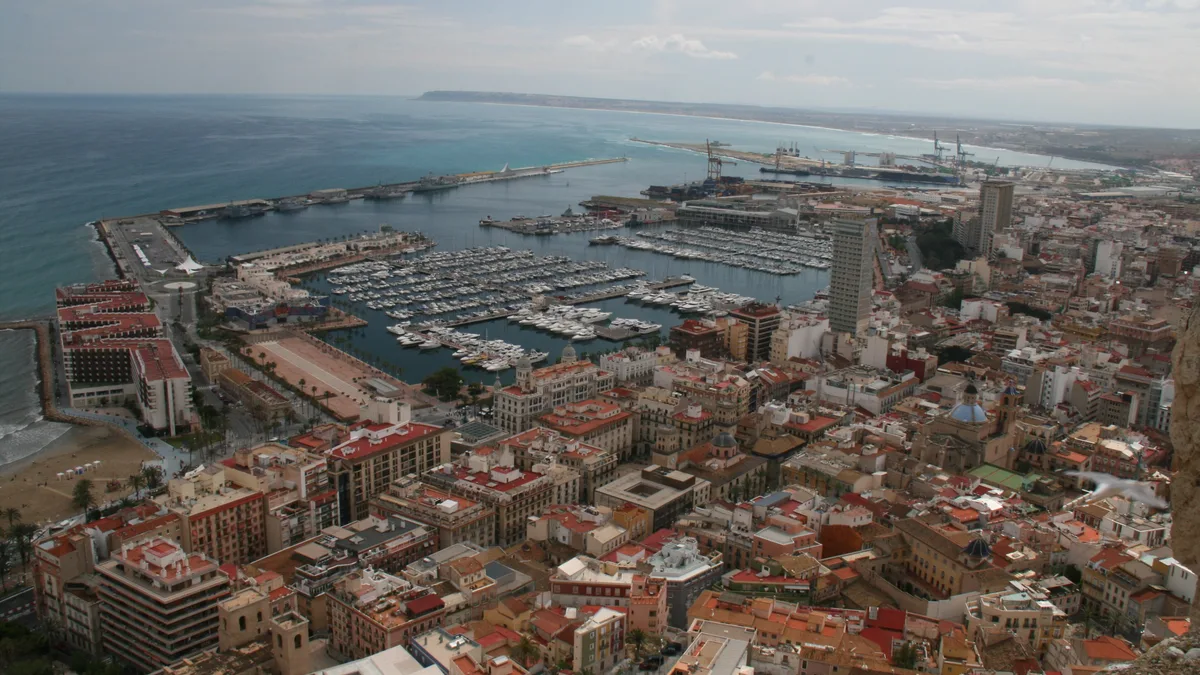
Header photo: Tamorlan, CC BY 3.0, via Wikimedia Commons. All credits: image credits.