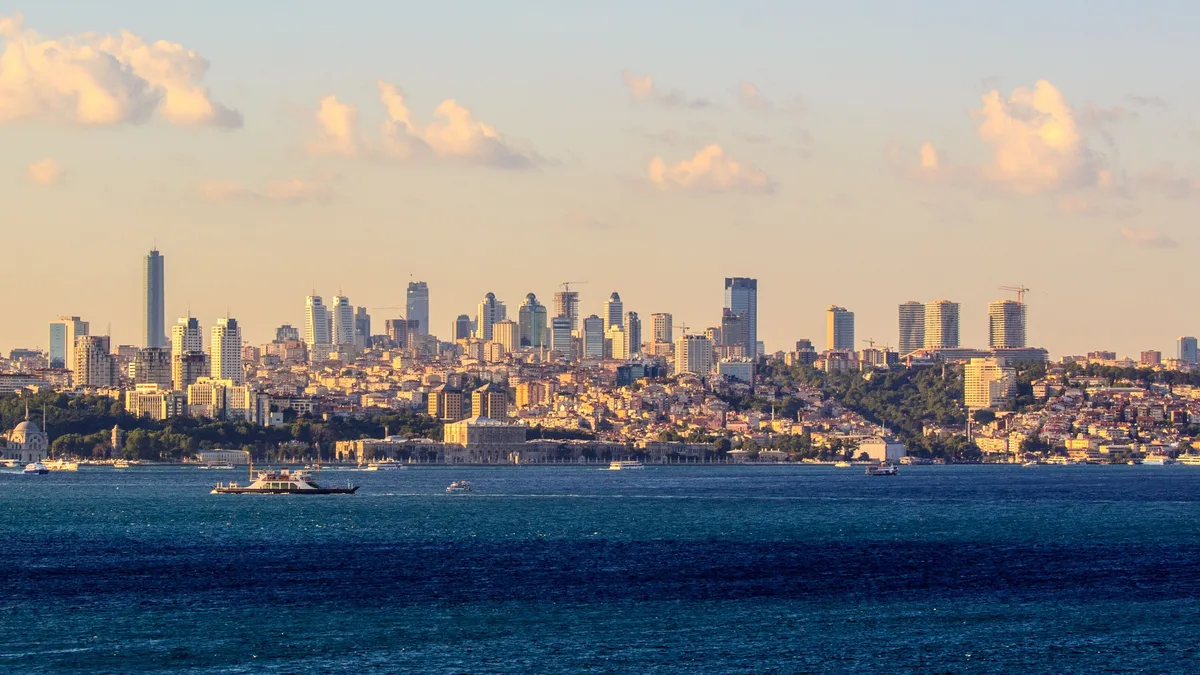
Can Russians buy property in Turkey? Still the largest foreign buyer group, in a much smaller market.
// Short answer
Eligibility in Turkey runs off a list of countries set by Presidential decision, and that list is not published, so it is confirmed for your nationality at any land registry office. On TurkStat's own figures Russian citizens have been the largest foreign buyer nationality every year since 2022, but the volume has fallen hard: 16,312 purchases in 2022 against 3,649 in 2025. Turkey then adds a currency rule that every foreign buyer has to satisfy.
Destination rules as of September 2026, taken from this site's own sourced cluster pages for each market, with buyer counts from TurkStat for Turkey and from figures given to the Cyprus parliament by the Department of Lands and Surveys. Written for Russian nationals already living outside Russia, in Dubai, Limassol, Istanbul and the other relocant communities. Nothing here is legal, tax, payment or immigration advice, and nothing here describes a route around any restriction. Banks, lawyers and payment providers run their own checks, those checks differ between institutions and change over time, so confirm your own position with your own bank and a qualified professional before you commit to anything. Every figure links to its source.
On this page
- Can Russians buy property in Turkey?
- How many Russians are buying property in Turkey now?
- What is the DAB currency certificate, and who needs it?
- Does buying in Turkey give citizenship or residency?
- What does it cost, and what does an owner pay in Turkey?
- Is there anything in Turkish property law that is specific to Russian buyers?
Can Russians buy property in Turkey?
Eligibility is decided by a list of countries set under Presidential Decision 2012/3504, reported to cover 185 countries, and that list is not public. Confirm your own nationality's position at any land registry office before anything else. Citizens of listed countries can buy freehold apartments, houses and land.
That is the actual position rather than an evasion. The land registry, TKGM, is the body that answers the question, and it answers it for free. Purchases by Russian citizens are plainly being registered, because TurkStat publishes them, but the registry is still where you confirm your own file rather than a sales listing.
Two limits apply to every eligible foreign individual. A cap of 30 hectares per person nationwide, and a rule that foreign holdings cannot exceed 10 percent of a district's private land.
The full position: Turkey foreign property ownership, explained.
Sources
How many Russians are buying property in Turkey now?
Far fewer than at the peak, but still more than any other foreign nationality. TurkStat recorded 16,312 purchases by Russian citizens in 2022, 10,560 in 2023, 4,860 in 2024 and 3,649 in 2025, a fall of about 78 percent, with Russia still first ahead of Iran on 1,878 and Ukraine on 1,541.
The 2026 data continues both halves of that sentence. Russian citizens bought 343 homes in Turkey in August 2026, still the largest single nationality that month, while total sales to foreign buyers between January and August 2026 came to 13,141, down 6.3 percent year on year.
Two readings for a buyer, and they point the same way.
- Being the largest group in a shrinking market is not the same as a strong market. The nationality ranking and the volume trend are separate facts and should not be quoted as one.
- A single month is not a trend. TurkStat publishes the nationality breakdown monthly and the order moves, so underwrite the annual series rather than a headline.
What the deed is and how the transfer is signed: the tapu title deed, explained.
Sources
- Daily Sabah: Turkish property market in 2025, TurkStat foreign buyer figures by nationality
- Daily Sabah: house sales in Turkiye, August 2026, reporting TurkStat data
- The Moscow Times: Russian citizens the leading foreign property buyers in Turkey, 2022 to 2024 (TurkStat figures)
- TurkStat: house and commercial property sales statistics (metadata)
What is the DAB currency certificate, and who needs it?
Every foreign individual buyer. The purchase price has to be brought into Turkey as foreign currency and sold through a Turkish bank, which issues the foreign currency purchase certificate, the DAB, and sends it to the land registry. The registry works from that document, so it is not optional.
Two other rules hang off the same requirement. The VAT exemption on a first new-build sale to a non-resident foreign buyer depends on the price being brought in as foreign currency, and the citizenship route depends on a documented 400,000 dollars. So the funding leg is the first question in a Turkish purchase rather than the last.
Banks and payment providers run their own checks on every buyer and on the source of funds, and those checks differ between institutions and change over time. Confirm your own position with your own bank, in writing, before you commit to a price or a completion date. This page states the published requirements and does not describe routes around any restriction.
There is no notary step in a Turkish purchase. The transfer is signed at the land registry office, the tapu mudurlugu, and the buyer receives the tapu senedi.
Sources
Does buying in Turkey give citizenship or residency?
There is a citizenship route with a property option at a minimum of 400,000 dollars, under Article 12 of Turkish Citizenship Law No. 5901, subject to a three year no-sale annotation on the title and a valuation report. A separate residence permit route runs off property of at least 200,000 dollars, and the address matters.
Two conditions do the work on the citizenship option. The three year annotation is recorded on the tapu, so the asset is locked for that period and the lock belongs in the underwriting rather than in a footnote. And a valuation report is required for that route, while the general valuation report for ordinary foreign purchases was dropped by the land registry.
On the residence permit route, the Migration Directorate has closed 1,169 neighbourhoods to new residence registrations. That makes the address, not only the price, the thing that decides whether a permit can be registered against a property. Check the specific neighbourhood before you make an offer.
Nothing in either route is specific to any one nationality.
Sources
What does it cost, and what does an owner pay in Turkey?
The title deed fee is 2 percent from the buyer and 2 percent from the seller, on a declared price that may not be below the property tax value, and compulsory earthquake insurance, DASK, must be in place before the registry will act. Annual building tax is 0.1 percent on a residence, doubled to 0.2 percent in metropolitan municipalities.
Building tax is charged on the tax value rather than the price, and the doubled rate applies in metropolitan municipalities such as Istanbul, Ankara, Izmir and Antalya. Rent is taxed at 15 to 40 percent on the 2026 brackets.
Two timing lines change an exit plan. A gain on sale is taxable for an individual only where the property is sold within five years, so holding period is a tax variable as well as a market one. And the VAT exemption on a first new-build sale to a non-resident foreign buyer is clawed back if the property is sold within three years.
The full stack: Turkey property tax for foreigners and Turkey property buying costs. The exit: selling property in Turkey as a foreigner.
Sources
Is there anything in Turkish property law that is specific to Russian buyers?
Nothing was found in the sources behind this page. The rules that decide a Turkish purchase are the country eligibility list, the closed military and security zones, the 30 hectare and 10 percent caps, the DAB currency certificate and the closed neighbourhoods for residence registration. All of them attach to a list, a zone or an address.
Military prohibited zones and security zones are closed to foreign buyers, and those zones are now recorded on the land register in all 81 provinces, so the office checks the register rather than corresponding with the military. Special security zones need governorship permission. That check happens before the deed, not after.
The useful conclusion is procedural. Because there is no nationality specific rule to look up, the whole file is the same file every foreign buyer assembles, and the differences between two buyers come from the address, the funding evidence and the timing rather than the passport.
Sources
// Buying abroad?
Every listing in your budget, ranked on net yield, appreciation and resale. Any market with public listing data; book a free call first so I can confirm your city has the data.
See the $499 report, page by pageFrequently Asked Questions
Can a Russian citizen buy property in Turkey?
How many properties did Russians buy in Turkey in 2025?
What is the DAB certificate in a Turkish purchase?
How much property gives Turkish citizenship?
Can a foreign buyer get a Turkish residence permit at any address?
When is a gain on a Turkish property sale taxed?
Header photo: Ben Morlok, CC BY-SA 2.0, via Wikimedia Commons. All credits: image credits.