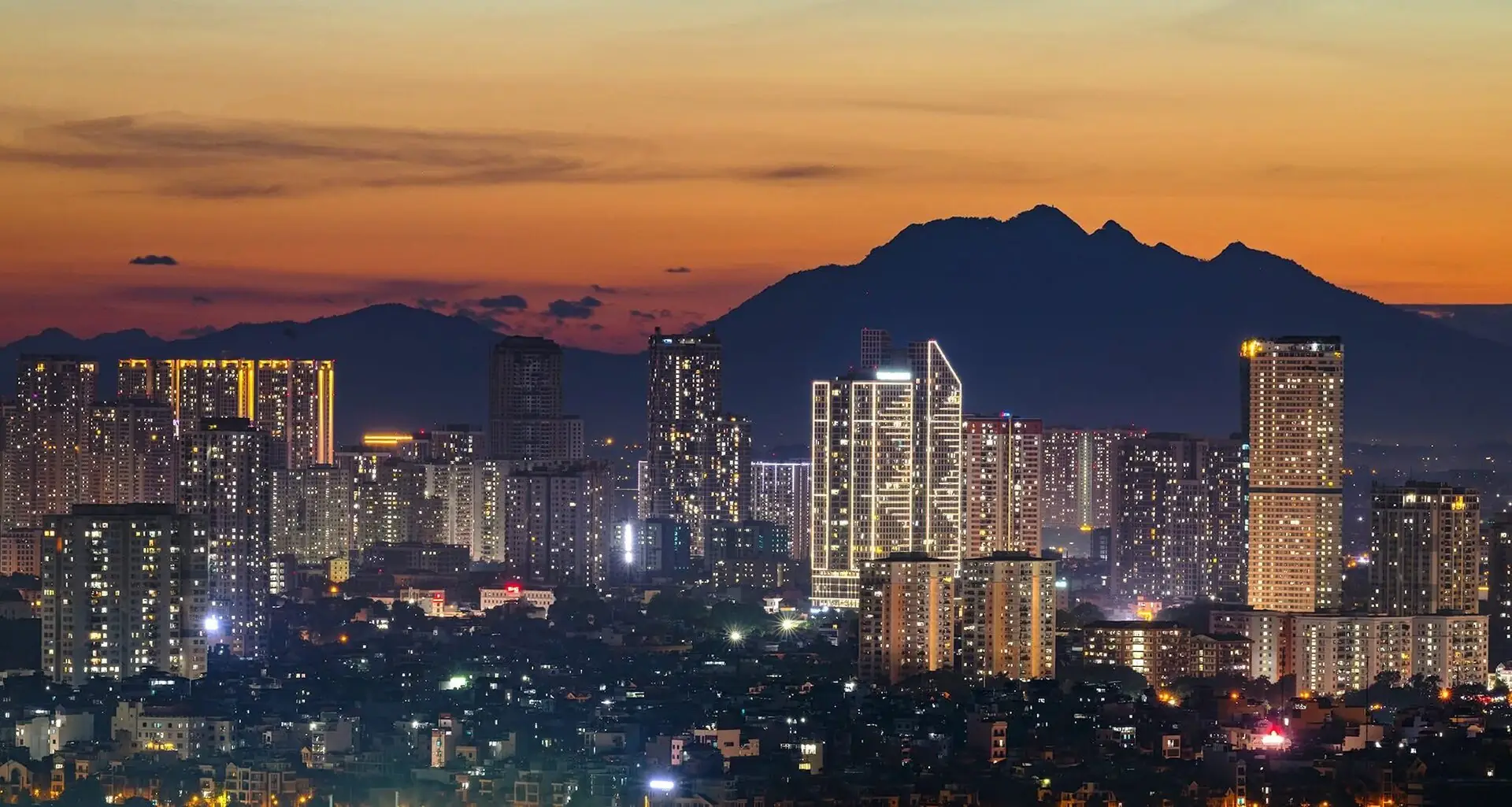
Hanoi's skyline — the Vietnam property market in 2026, city by city
Vietnam Market · 2026

The Vietnam property market in 2026: the buyer’s reality check.

Vietnam Property Market 2026 — The Buyer's Reality Check. Brinkman Data SEO brand card.

Vietnam in 2026 is not one market and it is not Thailand. A foreigner buys the dwelling for a 50-year term, never the land, inside approved commercial projects only, behind a 30% per-building quota. Every city below runs on a different tenant pool, a different exit pool, and the same legal clock. The brochure leads with the skyline. I lead with the certificate. The structural frame sits at the Vietnam foreign-buyer reality check.

30%
foreign cap per building
50 yr
dwelling term, renewable once
25,400
VND per USD, 2026 rate

The Legal Frame

The 2026 market sits on one law, not one mood.

I read the Housing Law 2023 and the Land Law 2024, both effective 1 January 2025. They are the spine of every number on this page. In Vietnam, all land is administered by the State — no private freehold for anyone, local or foreign. A foreigner gets something narrower: time-limited ownership of the dwelling, inside an approved commercial housing project, behind the building quota.

That is the whole 2026 story before a single ADR or appreciation figure. The market read is the easy part. The hard part sits one level down, at the building: a foreigner may own the dwelling for 50 years, renewable once, only up to the 30% foreign cap for that specific tower, and only if the developer actually issues the pink book. Two towers on the same street underwrite completely differently because one has quota open and a clean pink-book record and the other does not. Start at the 30% cap.

The brochure is built to close a sale, not to keep your name on a certificate at year seven. The law is built to do neither — it just is. Underwrite to the law.

The City Split

Long-lease cities versus short-let cities.

The 2026 market divides cleanly. Ho Chi Minh City and Hanoi are long-lease markets — sticky tenant pools, lower operational intensity, demand floors built on expatriate executives, diplomatic staff, and international-school families. Da Nang, Nha Trang and Phu Quoc are short-let markets — seasonal, operationally heavy, exit-thin.

In Ho Chi Minh City, District 1 carries Med appreciation projections in the 4–7% annualised band per the region-scout matrix, with thin yield and the worst rent-to-price ratio in the country; District 2 / Thu Thiem carries a higher projection band of 6–9% with the cleanest foreign-eligible new-build inventory. In Hanoi, Tay Ho is the steadiest long-let market in the country; Cau Giay / My Dinh trades a higher projection band for weaker resale.

These are independent-research projection ranges over a five-year forward horizon, not forecasts and not promises. Independent sources project both higher and lower bands. Use them as scenario inputs, never as point estimates in a model.

The Supply Caution

Oversupply is a building-level risk, not a headline.

The coastal short-let belt — Da Nang especially — carries visible new-tower supply against sharp seasonality. The mid-market Hanoi belt of Cau Giay / My Dinh has several large developments competing head to head; a tower that looks well-let in 2026 can face three new neighbours by 2028. The Tourist reads the launch render. The Operator counts the cranes on the surrounding parcels.

Supply compounds against your projected appreciation and against your exit at the same time. Underwrite the lease to the lower occupancy band, not the brochure's peak-season figure, and apply a real developer-track-record filter before treating any new-build projection as plausible.

The single largest gap between what a foreign buyer thinks they bought and what they hold is the off-plan pink-book delay — you pay across construction, take handover, list the unit, and still hold a contract, not a certificate, until the developer discharges its obligations. That is the generic off-plan risk, and oversupplied markets are exactly where it bites hardest.

78-page PDF · Instant download

Every number on this page, worked end-to-end.

The Vietnam Property Buyer’s Playbook walks the 30% quota, the 50-year clock, the pink book, the fee stack, and the exit math — the full framework this research page is built on.

Get The Vietnam Playbook — $39

Thailand vs Vietnam

Different model, different clock, different math.

A foreigner in Thailand buys a condominium unit outright under the 49% building allowance, registers a Chanote in their own name, and holds the asset with no clock on it. A foreigner in Vietnam holds the dwelling for 50 years, renewable once, behind a 30% cap, inside approved projects only. Same region, completely different instrument.

If your mental model was built in Thailand, Vietnam will feel like a downgrade on term and a constraint you did not expect on quota. Neither is a criticism of either country — it is a fact about two different legal stacks. The buyer who imports Thai assumptions into a Vietnamese deal underwrites the wrong asset. The buyer who rebuilds the model from scratch sees the trade clearly. If you are weighing the region as a whole, the Bali market read is the third comparison, and the free SE Asia Ownership Map lays the six-country ownership rules side by side.

The VND/USD rate sits near 25,400 in 2026; any unit figure you read is a hypothetical worked example that has to be recomputed against the live rate, because the documentation you create on the way in is the documentation you will need to repatriate sale proceeds later.

The Bottom Line

Choose the city with discipline. Choose the building with more.

The 2026 Vietnam market rewards exactly one posture: read every listing through three questions, in order. Is the building’s foreign quota still open? Does this developer actually issue pink books? Can you document a clean path to move sale proceeds out later? Get those three airtight and most of the market screens itself out — which is the entire point.

Amateurs buy the city. Operators buy the building. The framework filters the listings; the legal gate filters whether a filtered listing is even ownable. I would close in two of these markets and walk the other three. Which two depends on your operating mode, your resale-liquidity tolerance, and your appetite to run an actual operation.

// FAQ

Can a foreigner buy property in Vietnam in 2026?
Yes, within strict limits. A foreigner can own the dwelling — an apartment or a project house — for a 50-year term, renewable once, inside approved commercial housing projects only. The land itself stays administered by the State and is not available to anyone in freehold. Ownership is also capped at 30% of a building's units, so the building must have quota headroom before your name can go on a certificate.
Is the Vietnam property market a good investment in 2026?
It depends entirely on the city, the building, and your operating capacity. Long-lease markets like Ho Chi Minh City and Hanoi reward steady operators; coastal short-let markets reward experienced hospitality operators and punish passive buyers. Independent-research appreciation projections range from low-single-digit to high-single-digit annualised bands by sub-market. Treat them as scenario inputs, never as promised outcomes.
How does Vietnam compare to Thailand for foreign buyers?
They are different legal instruments. Thailand lets a foreigner own a condominium unit outright with a Chanote and no clock, under a 49% building allowance. Vietnam grants the dwelling for 50 years, renewable once, behind a 30% cap, inside approved projects only. A buyer who imports Thai assumptions into a Vietnamese deal underwrites the wrong asset. Rebuild the model from scratch.
Is there a condo oversupply risk in Vietnam?
Supply risk is real and it is building-level, not headline-level. Coastal short-let belts such as Da Nang and mid-market Hanoi belts such as Cau Giay and My Dinh show active new-build pipelines. New supply compounds against both your projected appreciation and your exit. Underwrite to the lower occupancy band and confirm the developer's track record before treating any projection as plausible.
What law governs foreign property ownership in Vietnam?
The Housing Law 2023 and the Land Law 2024, both effective 1 January 2025. They set the 50-year dwelling term, the renewable-once extension, the approved-commercial-project requirement, and the 30%-per-building and 250-houses-per-ward quotas. Nothing an agent says overrides them. Engage a licensed Vietnamese lawyer to confirm the specific building and unit before any deposit.

Related research

// Same math, other markets

THREE QUESTIONS, EVERY LISTING

Is the building’s foreign quota still open. Does this developer actually issue pink books. Can you document a clean path to move sale proceeds out later. Get those three airtight and most of the 2026 market screens itself out. The quota mechanics sit at the 30% cap.

Read The Market Through The Law

The Vietnam market, underwritten.

The legal frame. The city-by-city split. The oversupply checks. The Thailand comparison. One PDF, built for the operator, not the tourist.

Get The Vietnam Playbook $39

Or start free with the SE Asia Ownership Map — who can own what across six countries.

Instant PDF · 7-Day Guarantee · Secure Checkout

⚠ Disclaimer

Brinkman Data Analytics is an independent research service. Not financial, investment, tax, or legal advice. Vietnamese property law is jurisdiction-specific and governed by the Housing Law 2023 and Land Law 2024. Engage a licensed Vietnamese lawyer and a qualified tax adviser before acting. International real estate carries risk of partial or total loss of capital.

Get The Vietnam Playbook $39